OPERATION MELT ‘FACES’: Nearly $1 million Value ‘Melted’ by Collectors

The numbers are now in for an ambitious NFT experiment that challenged collectors to “melt” an extremely popular NFT in exchange for a reward: Nearly a third of holders of the SSX3LAU piece “FACES” participated in the operation, pouring almost $1,000,000 in estimated value into this digital smelting operation.
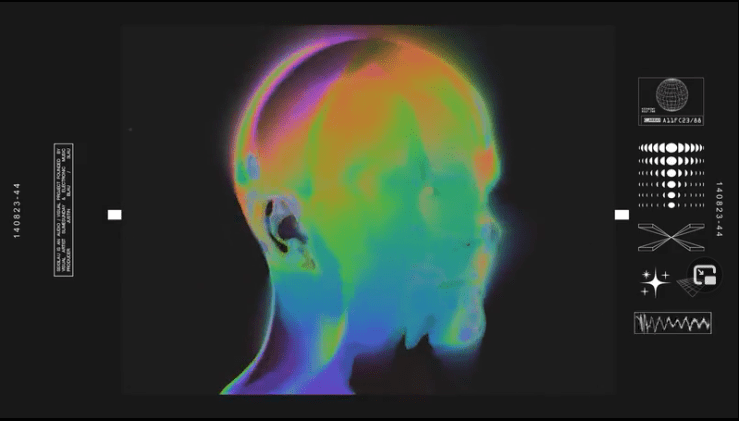
A face made up of bright shapeshifting colors spins slowly

At the time of writing, the value return for all participants has been underwhelming. Since the event, which took place around the peak of the frenzy in the Nifty Gateway marketplace, prices for most NFTs – including FACES – have cratered. GLASS, the piece given to collectors who burned the most FACES, has been selling for less than its established value of six times the price of FACES.

Those who melted one edition FACES have yet to receive their promised loyalty token, so the value of that piece has yet to be established. But it seems unlikely to match the value of a FACES piece based on its own merits. (UPDATE 5/7/2021: the loyalty tokens were distributed today and are much cooler than was initially previewed.)

Despite this, OPERATION: MELT FACES was a useful experiment in NFT tokenomics that offers many lessons to artists and collectors. And, as any HODLER knows, near-term price changes are not necessarily reliable indicators of long term value. Upside remains for holders of these pieces given the artists’ intentions to reward long term holders of their work.

My findings are based on original research and analysis. I used Dune Analytics to review the transaction data that was publicly available around OPERATION: MELT FACES, and combined that with numbers gleaned from the Nifty Gateway ecosystem.

In this piece I will walk through my analysis of the operation, the current state of the market after the burn, and my personal reflections on how the event went overall and how it could have been improved.

BACKGROUND: OPERATION MELT FACES

Last month, NFT superstars Justin Blau, known as 3LAU, and Mike Parisella, aka Slime Sunday, announced a surprise: holders of their multimedia NFT piece “FACES” were invited to destroy their editions in order to receive a new piece of art. They called this OPERATION: MELT FACES. (The artists’ combined alias is SSX3LAU. FACES was released in the IRIDESCENT Open Editions collection on Nifty Gateway on March 13, 2021.)
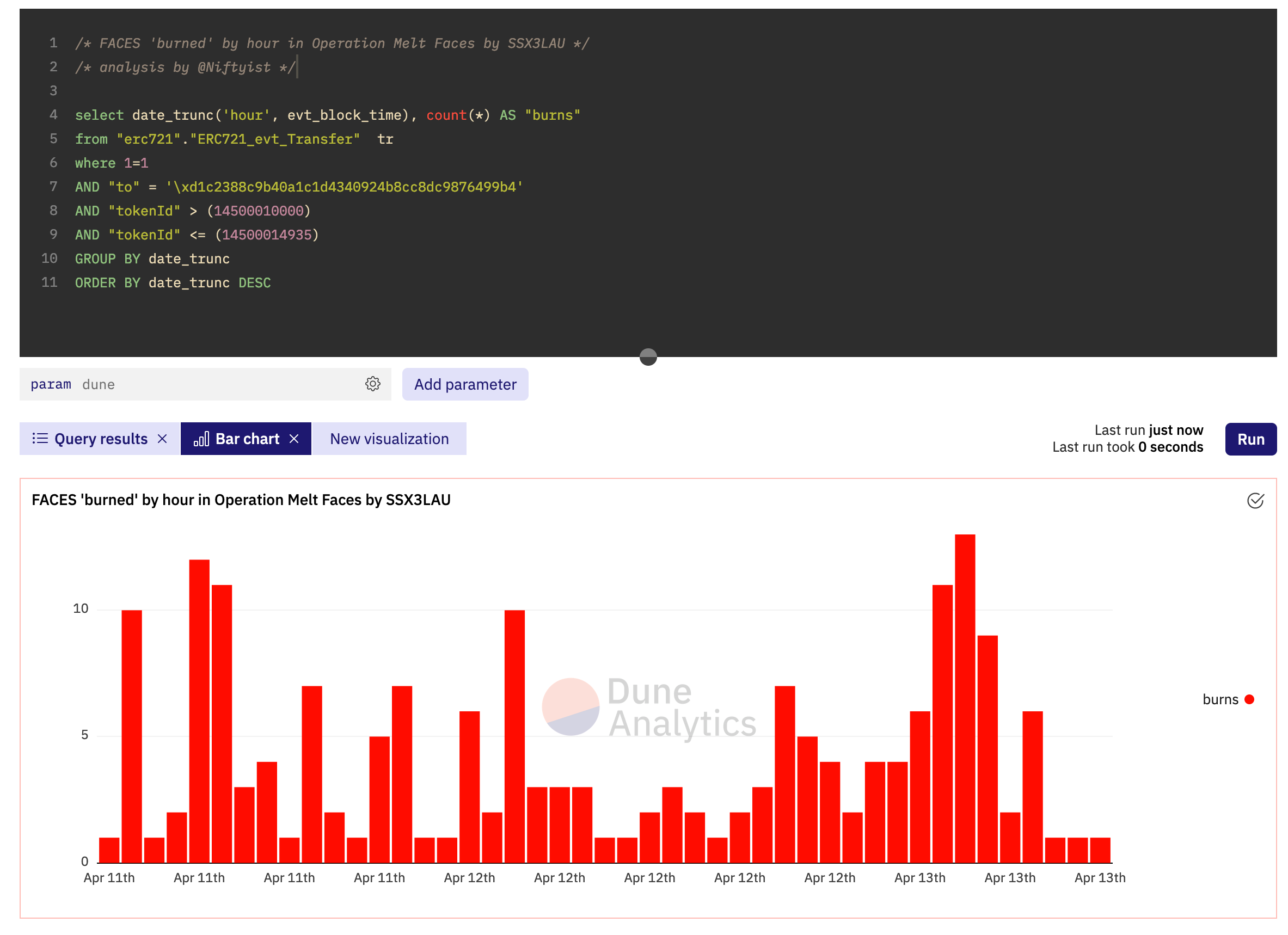
A bar graph shows sporadic increases over a 48 hour window

I participated in the event by buying an edition of FACES and “melting” (or “burning”) it in the specific manner described by the artists. In return, I was promised an NFT that will act as a loyalty token for future 3LAU/Slime Sunday events. (I have faith it will come, although at the time of writing, this token has yet to appear in my wallet.)

Burning an edition of FACES was always a risky proposition. It was the most popular piece in the Nifty Gateway secondary marketplace by trading volume. The value of FACES fluctuated wildly in the lead-up to the burn, rising from its opening price of $333 to, at times, around $1,000. Around the time of the operation, pieces were trading for around $700 (which is about what I picked my edition up for).

And the return on the burn was uncertain. How would the market value of “GLASS,” the piece gifted to holders who burned 6 FACES? How would the market value the SSX3LAU “loyalty token” distributed to holders who burned 1 FACES? How would the market reward the remaining editions, whose supply would be reduced and who would come to symbolize a certain type of loyalty to HODL idealism?

Knowing that both artists are invested in the NFT space for the long term, and 3LAU in particular has spoken about how he plans to reward holders of his art, I decided to take a shot at the burn myself. For science. And the thrill. And for the intriguing, ineffable value of an early SSX3LAU loyalty token.

ANALYSIS

For weeks, I’ve wondered about the success of the experiment. I had not seen any announcements about the operation by the artists after the burn. Had it been a flop?

When I discovered Dune Analytics this weekend – a dashboarding platform that allows for analysis of the Ethereum network using simple SQL queries – I realized I had the tools I needed to answer that question. I decided to make this the subject of my first investigation. (Make sure to check out the full dashboard associated with this post!)
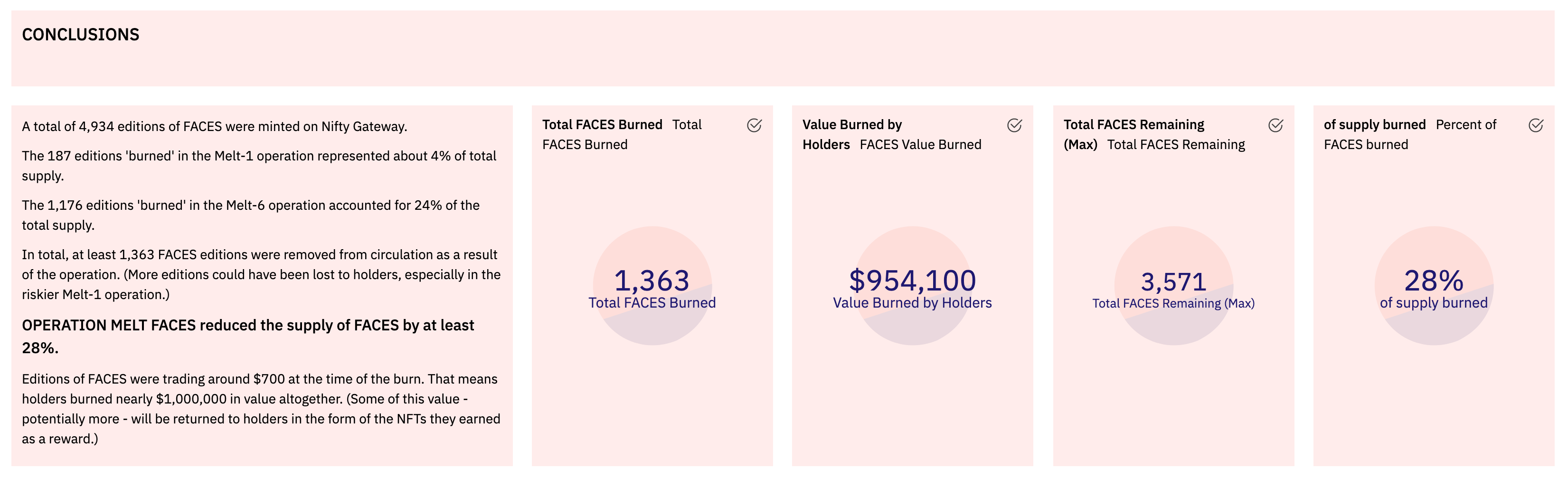
By analyzing the trading activity related to the “FACES” tokens and the designated burn account, and inferring from numbers available in the Nifty Gateway marketplace, I concluded that at least 1,363 FACES, representing a combined value of $954,100, were “melted” in the burn. (Note that this value didn’t necessarily disappear: Those who burned FACES will retain the value of whatever tokens they receive(d) in reward for the burn.)

IMPACT ON PRICE

FACES had been one of the most successful offerings ever on Nifty Gateway, with nearly 5,000 pieces minted. The FACES burn reduced supply of the piece by at least 28%. Yet, despite the sacrifice of over 1,000 pieces, we did not observe an increase in the value of FACES immediately after the event. Rather, price fell considerably almost immediately after the burn. Thus, the operation did not achieve a boost in demand for the piece, at least in the short-term.

(Note that in the roughly two weeks since the burn, prices have collapsed across the entire secondary market on Nifty Gateway. FACES and GLASS have not been spared from this phenomenon, which makes it difficult to isolate the effect of the operation on prices of these two pieces.)

At the time of writing, FACES is trading for around $400 in the Nifty Gateway secondary marketplace. Niftysecondary.com shows a steady gradual decrease in value from around $450 on April 16th, the farthest back date for which data was available. (The burn event concluded at 12AM pacific time on April 13.)

At the time of writing, the last four editions of GLASS traded hands for just $2,000 – less than the estimated value of 6 FACES at the time of the burn ($4,000), and less than the current value of 6 faces (about $2400).
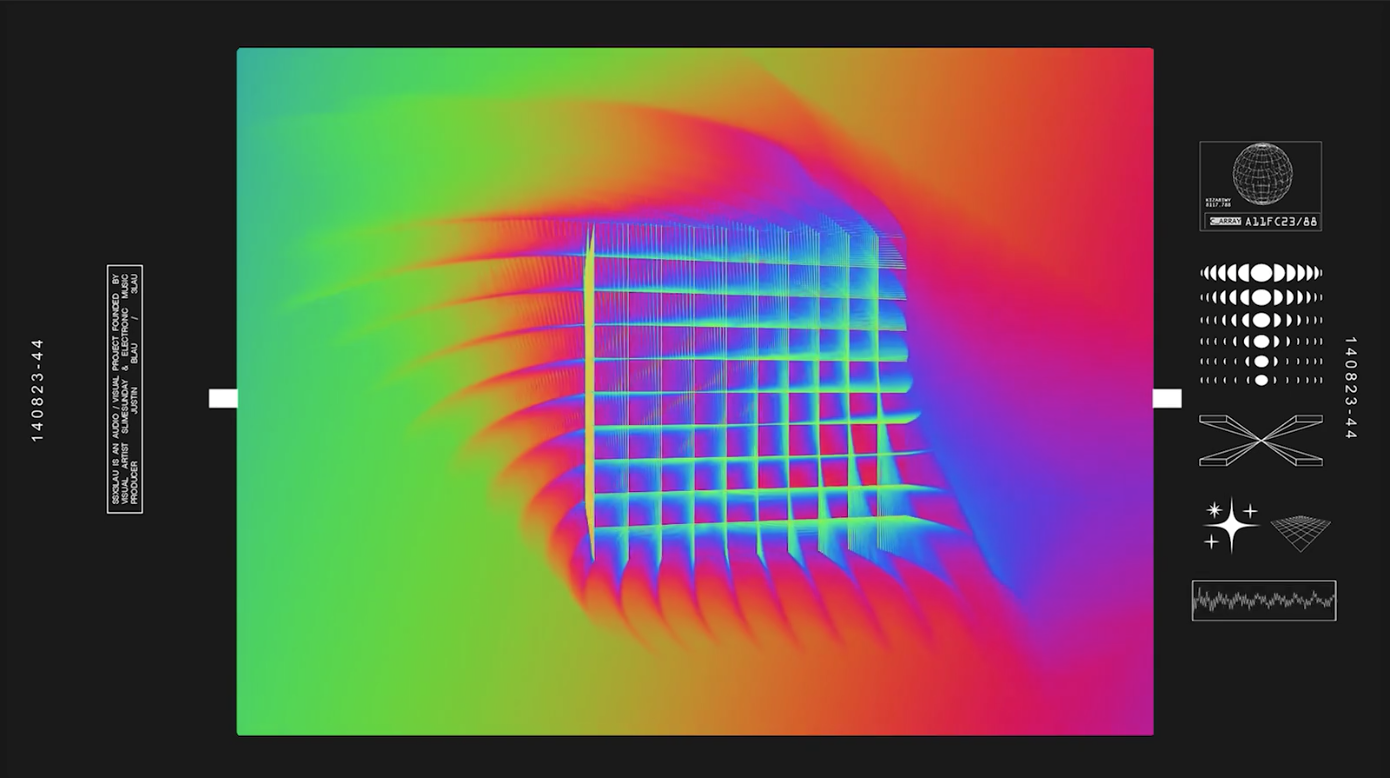
A 9x9 cube made up of bright shapeshifting colors slowly spins

MISSION ACCOMPLISHED?

Was the experiment successful? From a participation standpoint, I do think it’s impressive that the artists managed to engage almost 30% of buyers in this elaborate and novel scheme. That being said, I think the participation rate could have been higher, as I will explain in the next section.

From a value standpoint, I do not think OPERATION: MELT FACES achieved its goals, as far as we can judge in the present. OPERATION: MELT FACES had the potential to be a value-add exercise for all four parties involved:

The artists, who benefit from a 10% resale fee any time FACES or GLASS is traded

In my estimation, the four parties not only made out quite differently, but there was actually a value transfer that created winners and losers from the operation.

The artists made out the best, having collected thousands of dollars in pure profit from resale fees as prices rose and then ultimately fell around the event.

“Melt-6 collectors” were rewarded with a very cool, unique NFT. Although the value of this piece is down right now, I personally believe that if NFT prices are to recover at all to where we saw them in March, GLASS is a prime candidate to reach a premium price due to its limited supply, obvious audio and visual quality, its association with the two artists, and with OPERATION MELT FACES.

Collectors who held on to FACES have not seen the value of the piece increase in the wake of the operation, and I do not expect they ever will. (More on this in the next section.)

“Melt-1 collectors” seem to have fared the worst in the experiment. Based on pure aesthetics, the NFT they received in return for the risk they took on is clearly of lesser value than the original piece. (More on this in the next section.) Not to mention, since it is being distributed outside of the Nifty Gateway closed ecosystem, there will be hefty fees associated with any trade of the loyalty token. For their sake, I do hope SSX3LAU does their best to create long-term value for holders of the token. (UPDATE 5/7/2021: the loyalty tokens were distributed today and are much cooler than was initially previewed.)

From an artistic and entrepreneurial standpoint, I love the concept of OPERATION: MELT FACES, and I think it was well worth undertaking. This type of experiment highlights the unique value of NFTs and is a fun, tongue-in-cheek way to explore the many possibilities they open up.

But since the operation failed to create value for all holders involved, my overall view is that OPERATION: MELT FACES should be considered a mixed bag at best. I think the artists would agree with me that fans who were bold enough to participate in the experiment should be rewarded with some sort of fair value exchange, if not a value add. And if the ultimate winners from the exercise were mostly the artists, that risks turning off fans and collectors in the long term.
The camera zooms in to endlessly repeating rows of the letters SSX3LAU, white on black

CONTRIBUTING CIRCUMSTANCES

In this section I’ll explore the factors that I believe contributed to the disappointing result.

In one important aspect, the project was a victim of its own success. The astronomical minting numbers from the open edition drop may have doomed long-term FACES holders from the start. 5,000 editions is an almost unheard of figure in the Nifty Gateway world, and was a record for Nifty Gateway at the time. As a result, the market was flooded with these pieces. The price after the burn reflects the continuing glut in supply and relative lack of demand. (Two notes here: the IRIDESCENT drop probably got a major boost by lucky timing – happening to take place right at the peak of NFT mania on Nifty Gateway. It’s worth considering, too, as the market deflates, whether FACES contributed to the bubble burst by pulling in new NFT buyers who soon found themselves holding an item bound for deflation.)

Inconsistent communication added another issue to the mix. SSX3LAU had first promised those who melted 1 FACES that they would receive nothing but a single entry for a giveaway in return for the burn, before offering instead the loyalty token in addition to the giveaway entry. This may have led to confusion from holders, and/or turned off many who felt the burn would not be in their interest (who would give up value for nothing?).

In addition, I personally think the actual loyalty token offered was not a good value match for FACES, and fair to call “lame.” The artists’ announcement makes clear that the token was not only a second thought, but also not the result of a thoughtful creative process: “one of our first NFT experiments in 2020, slimesunday made this animation while messing with logo concepts.” (UPDATE 5/7/2021: the loyalty tokens were distributed today and are much cooler than was initially previewed.)

One other reason I believe the participation rate was lower than it could have been is that I did not observe much publicity around the Operation during the launch. Apart from one tweet from 3LAU, I didn’t encounter any other reminders that the melting was in progress. I believe SSX3LAU could have used their platforms more aggressively to get the word out.

Finally, one potential contributing factor to the large drop in price could be competition. Soon after the FACES burn, the much more publicized multi-day drop by PAK on Nifty Gateway employed a similar burn mechanism – and that drop, too, succeeded in minting thousands of open edition pieces. It’s possible that the PAK experiment stole some of SSX3LAU’s thunder – and demand.

PREPARING FOR FUTURE MISSIONS

In order to create the most value for fans, and not just the artists, future exercises modeled off of OPERATION: MELT FACES should take heed of the above circumstances, and make one key change in the structure.

Instead of releasing the initial token as an open edition, which introduces variability into the total number of editions minted, future artists following this model should limit the drop size to a fixed number of editions. The number should err on the small side in order to ensure continual demand for the piece during and, crucially, after the operation. Consider that if even 1,000 editions of FACES had been released, a similar burn rate of 28% would have left over 700 pieces still on the market – still many more editions than in vast majority of collections, and a number almost sure to deflate demand.

OPERATION: MELT FACES was an exciting exercise to participate in, and one that was highly affected by the time of its release. Despite the less-than-stellar value produced for some holders, it will remain an innovative drop structure and an important case study in how to optimize value for fans in similarly structured releases.

Holders of the FACES and SSX3LAU loyalty tokens will at least be able to point to an interesting piece in their collection that was part of a pioneering experiment in NFT tokenomics. And, who knows – it may turn out that in the coming months and years ahead, these tokens may still hold secret value yet to be revealed.
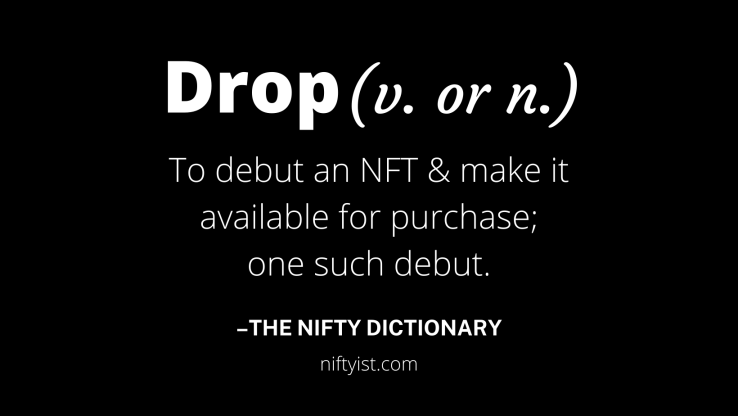

The Nifty Dictionary: Drop

Dropping is a slang term that means to debut or to become available for purchase.

A drop is the release of one or more NFTs for purchase at a particular time and place.

The phrase drop implies that there will be strong demand for the release – therefore, it’s often used by in marketing or promotional materials to make a release sound more exciting.

Curated NFT platforms like Nifty Gateway, MakersPlace, and KnownOrigin have regular drops several times a week (or even several times a day!), in which one or more artists release a new NFT collection for purchase. Releasing these at a regular, advertised time helps drive excitement and demand for the work and for the platforms themselves. To add to the excitement, some NFTs are only available for purchase at the time of the drop – so if you miss the drop, you’ve lost your chance to buy directly from the creator!

The term drop comes from hip-hop culture, where it’s used to hype the release of new albums. The phrase has since been appropriated by the mainstream music industry (and other industries) to refer to the release of any album, song, artistic, or commercial release.

The Popping of the Nifty Gateway Bubble

Something bizarre happened this week when Duke Dumont dropped his debut collection on Nifty Gateway: only one person bought into an open edition piece, effectively turning what should have been a solid middle-tier open edition NFT into a unique 1 of 1.

The piece, Morganite, was a collaboration with LOREM in the DREAM LOGIC Open Collection. This stunning, subtle video loop was priced at $1,500, which marks it as a mid-to-high tier item by the pricing standards on Nifty Gateway in recent months. (The lucky buyer has now listed the piece for a cool $3,333.)

It’s not clear exactly why only one edition sold. It’s possible that buyers experienced technical issues when trying to check out – a dishearteningly common experience on Nifty Gateway.

But it’s also possible that there was simply no demand for this NFT. My hunch is the latter.

(As a contributing circumstance, I would point to the fact that there was another open edition piece in the same collection that was extremely similar to Morganite, but priced $1,000 lower. That piece, Amethyst, sold only 9 editions. In my opinion, the pieces were not differentiated enough for most buyers to justify spending the extra 1k on Morganite.)

Malavida Stage 2 Drop Falls Flat

But Dumont is far from the only artist whose drops have been met with lackluster demand in recent weeks. Malavida, a celebrated NFT artist who had a successful previous release on Nifty Gateway, also released a drop this week that struggled to meet the expected demand. Her collection was called Onboarding โ€” Heal The Deal Stage 2, and appeared to be only open to those who had purchased pieces from her first collection.

Each piece the Stage 2 main collection was released as a drawing, with four of the five pieces priced at $1,499 or higher. Despite selling 180 editions of her first drop, patrons of Stage 1 did not seem to take advantage of their exclusive access to stage 2: only 14 editions of the $1,499 piece were sold, and a combined 21 editions were sold of the 3 pieces priced at $1,900.

Now, those sale numbers, I would argue, are nothing to sneeze at. But what takes the shine off them is that the drawings for most of the above pieces were limited to 40 editions. Which means that even the best-selling piece in that collection only sold 8 pieces – a dismal 20% of the edition limit.

Perhaps this was as expected, and they just wanted to be safe and place an upper limit on the drawings. (I say ‘they’ as my understanding is that the artists work with Nifty Gateway to determine optimal pricing.) But in general, drawings have low limits, so that demand is much higher than supply, which ensures that it’s exciting to actually win. I’m going to guess they were expecting more of the Stage 1 crew to follow through on this drop – much more.

This may have challenging implications for Stage 3 of the project, which will feature the ability for holders to combine their works into diptychs and triptychs. Hopefully, Stage 2 owners are aware of the privilege they purchased for what promises to be an interesting finale.

Trouble Across the Board

Judging by the conversation in various Discords and on Twitter, market watchers have noticed an unfortunate trend on Nifty Gateway in recent weeks – declining demand across the primary and secondary markets.

An informal survey of a variety of metrics – the number of open editions minted in recent drops; the number of drawings entered; the number of higher-priced pieces being snapped up; and the final sale price of auctions – suggests the money has stopped flowing from collectors at the generous rate it was in February and March.

There could be any number of reasons for the slowdown, and the niftysphere certainly is awash with theories. Many complain that Nifty Gateway has focused too much on quantity over quality, flooding the marketplace with big-name artists hawking expensive pieces, and middling-quality art. For all of the new blood entering the NFT space since the beginning of the year – and there have been many, many newcomers – NFTs remain an extremely niche market, and there are only so many collectors out there, with so many dollars. Market saturation is a real threat.

Panic in the Secondary Market

We’re seeing demand drop not only in the primary market, but the secondary as well. A number of pieces that I have collected are now selling below their initial list price. This is a particularly ominous sign for pieces that were priced below what seems to be the market standard of $700 and up. If the affordable pieces can’t keep their declared value, what does that say about the rest of the market?

On Twitter today, Duncan Cock Foster, one of the cofounders of Nifty Gateway, admitted that Nifty Gateway bears some responsibility for the current bearish situation, and implied they have hurt the health of the secondary market.

The NFT bubble of spring 2021 may be popping before our eyes. Here are some of the questions that come to my mind for me as we finally cross this inevitable threshhold into a more rational pricing environment on the best-known curated NFT platform.

Will this first wave of NFTs released on Nifty Gateway and other curated platforms hold their value long term?

The Nifty Dictionary: Gas

On the Ethereum network, gas is a fee that must be paid to the network in order to make a transaction.

Gas is paid directly to miners to compensate them for their computational effort used to run the network. It’s called “gas” because of the easy analogy to driving: to go anywhere in a car, you must make sure you have enough gas in the tank to cover the distance. Similarly, to complete the transaction you want to make, you must make sure you pay enough gas to cover the cost.

I prefer to think of gas fees as automated taxes. Both are required fees paid by beneficiaries of the network (citizens) to cover the costs incurred by running the network.

Gas fees will arise when interacting with the network in a number of ways, including minting an NFT, purchasing an NFT, and sending an NFT from one wallet to another.

While gas fees may seem inconvenient, annoying, and at times expensive, gas is a critical part of the Ethereum network. Gas fees incentivize miners to run the network, disincentivize spam by giving every transaction a cost, and prevent infinite loops, since a transaction will fail once gas is depleted.

Nevertheless, paying fees on a per-transaction basis is not always ideal, especially for low value transactions, when gas fees can approach or exceed the value of the payload.

Ultimately, high gas fees can even disincentivize people from joining or using the Ethereum network.

For this and other reasons, developers are focused on building technologies that minimize or eliminate gas fees for many interactions with the Ethereum network. One such scheme in the NFT world is “lazy minting,” in which an NFT is not actually created on the network until it is purchased, in order to save the seller upfront cost. Other solutions include “layer twodapps and marketplaces which allow users to conduct most transactions within a network built on top of Ethereum. This can save users from having to make frequent or one-off calls to the Ethereum blockchain by batching transactions.

An Artist Donated This Innovative NFT to the Public. Someone Stole it Immediately.

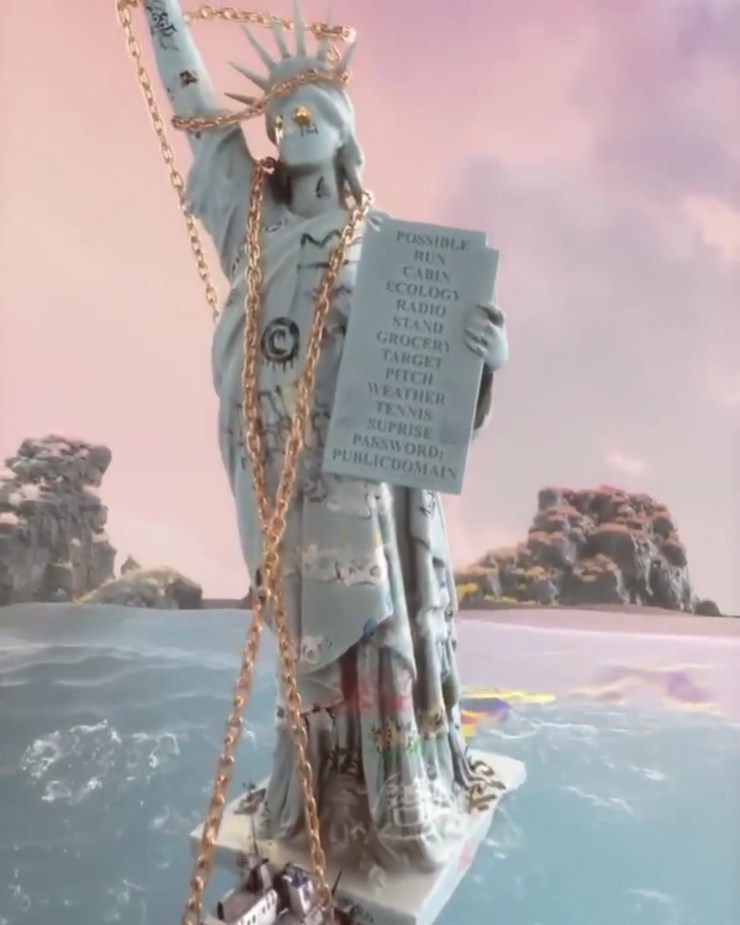
Last week, artist Steven Baltay, who goes by the handle @realimposter on Instagram, minted a and daring experiment in NFT art. He called it Public Domain, and declared that, “This NFT will belong to the public. The artwork itself holds the seed phrase to the wallet containing it. Please do not buy, sell, trade or destroy this art. It belongs to everyone.”

The work shows a graffitied Statue of Liberty bobbing atop an undersized cargo ship in rough seas. Liberty is chained to the ship; the golden chains sway and clink, tangling around her crown and torch. Her tablet is clearly visible, and on the tablet is inscribed the seed phrase of the wallet holding her.

For those unfamiliar, a seed phrase is a 12-word phrase that acts as a recovery mechanism for a crypto wallet. The phrase must be kept secret, or else the contents of the wallet will become forever accessible to intruders. An NFT, as a tradeable object living on the blockchain, must be kept inside a wallet. Baltay had set up a dedicated wallet, placed this Public Domain inside it, then effectively gave the keys to the public.

It took about one hour for liberty to be snatched.

According to the transaction history on Opensea, a collector with the username FriesFrame transferred the NFT to their own collection shortly after it was minted. On Twitter, FriesFrame (@ChasFries) replied to the artist’s tweet announcing the piece, saying, “nabbed it ๐Ÿ˜†.”

When a user challenged Fries Frame, asking, “Doesn’t it literally say “don’t transfer it”

๐Ÿ˜‚๐Ÿค””, he defended himself on a technicality: “it does not – it just says dont buy, sell, trade, or destory….i traded nothing for it”.

According to Fries Frame’s Twitter bio, he is a Chicago based collector and “Niftygateway Moderator” (Discord?). He seems to be quite active in the space, tweeting frequently about NFTs, and his Opensea profile shows a collection of dozens of pieces.

On Twitter, I asked him what he was intending to do with the piece – lock it up indefinitely (that is, to hold it) or turn it for a profit (sell)? His answer – “why are those the only two options?” – was noncommital.

It’s interesting to consider Fries’ options. If he holds it, he can claim the distinction of being the only owner of this unique NFT – though that will always come with some notoriety. He could sell it, certainly, and any price he charged would be pure profit into his pocket. But to return the piece to the original wallet would presumably cost him gas fees – meaning if he chooses to put it back in its place, he will actually need to pay money to do so. At the time of writing, the gas fee might range from $50-$100 – not quite pocket change (at least in USD!). What would you do?

I love this piece as a tribute to and a test of the technology it’s built on. It wouldn’t work as anything other than an NFT. Because of the blockchain, we can always know who owns it, and who has taken ownership of it at any point in time.

At face value, Public Domain is an optimistic yet naive tribute to the crypto community. But being born of the community itself, I think we can conclude that it is in fact a statement on the value of trustlessness – central to blockchain technology and crypto ideology. When you allow people to take something for free, they will. Passwords, seed phrases, wallet keys, and all the other accoutrements of the blockchain are the essential tools that enable this community to thrive in spite of our tendencies toward opportunism.

With all of the excitement in the crypto space last week – the Coinbase IPO, the multi-day Pak drop extravaganza on Nifty Gateway, the Artvatars launch, and the Paris Hilton NFT debut – Public Domain seemed to fly under most people’s radar. I believe that this piece is an early classic of NFTs, and whoever owns it – Fries Frame, the public, or anyone else – will be holding a piece of history.

The Nifty Dictionary: Mint

DEFINITION

Minting means creating a new NFT. Recall that NFT stands for non-fungible token. Just as a metal coin must be minted in the real world, a non-fungible token must be minted digitally. The token is minted on a blockchain such as Ethereum, a public database where it can be stored, traced, and traded. To mint a token is to create a new entry in that database.

In most cases, the true NFT โ€“ the piece stored on the blockchain โ€“ is just a few lines of code, and does not actually contain the content that is of value, such as a picture, video, or song. That’s because storing content on a blockchain is usually quite expensive. In most cases, content is stored elsewhere, and the proper NFT just contains a reference to this content.

Therefore, minting an NFT is often a dual process in which the creator uploads the file for hosting while simultaneously creating a token referencing it on the blockchain. Minting services try to make this process simple for users and may not make the distinction clear. Depending on the service, they may host the NFT on their own servers for convenience.

This disconnect is one huge issue in current NFT technology. When minting an NFT, it is important to know where the content will be hosted, so you can consider how safe and trustworthy that source is. URLs are considered risky addresses, because whoever owns the URL can change what it points to.

For this reason, many people prefer to see NFTs stored using a process called content-addressing on a network such as IPFS or Swarm, which ensures that the link can only ever point to that unique piece of content. Even this approach has issues though, as items stored on such networks must still be hosted and maintained to exist in the future.

When minting (or purchasing) an NFT, make sure you know where the content will live, and that you trust that it will live there for a long time. Otherwise, the buyer may get stuck with owning a permanently broken link.

Collect this Crypto City NFT: Barcelona

Note: As of 3/29/2023, I own an NFT in the CryptoCities Suburbs collection. I therefore have a financial stake in the CryptoCities brand. Links on this page may contain affiliate codes for OpenSea that could compensate me in the event you purchase an NFT.

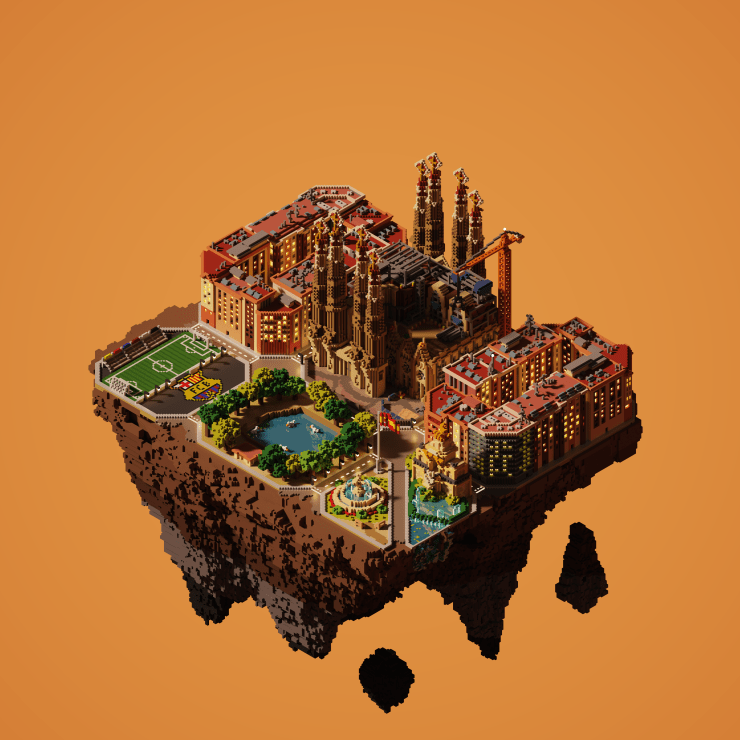
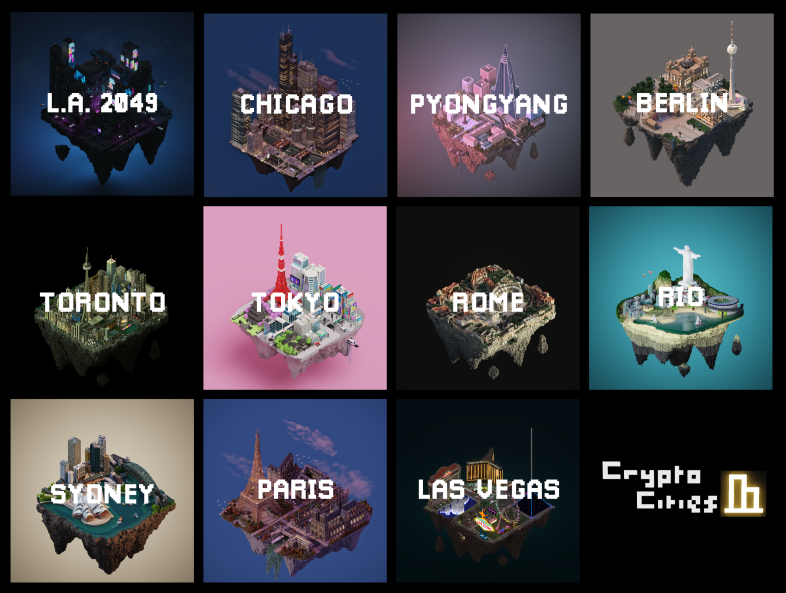
This intricate piece caught my eye today on /r/NFT, as it’s no doubt already caught yours: a voxellated city floating in a burnt orange sky, steeples and and a crane piercing up from the center. This is “Barcelona”, the newest piece in the Crypto Cities collection, featuring the famed, and famously incomplete, La Sagrada Famรญlia cathedral.

The Crypto Cities project describes itself this way:

An art collection made up of voxel-based microcosms displaying iconic cities from real life/fiction. Only 123 unique cities to be minted.

This is a gorgeous collection, with each city featuring a unique ambiance crafted around its most beloved landmarks: Paris‘s Eiffel Tower; Rio‘s Cristo Redentor; and, my favorite, the crumbling Colosseum of Rome.

You can check out the other cities minted so far on OpenSea, including Tokyo, Los Angeles, Sydney, Berlin, Shanghai, and the surprising Pyongyang. Any one of these cities would make an impressive centerpiece in a collector’s portfolio – and I certainly hope to have that honor one day!

The Nifty Dictionary: NFT

DEFINITION

NFT stands for Non-Fungible Token, which is crypto jargon for a unique digital item. Non-fungible simply means that two items are not exactly interchangable, the way that two tickets to the same concert may not be interchangable (perhaps one ticket is for the front row and one is for the nosebleed section) even though the money that you paid for them is interchangable (it doesn’t matter which dollar bills, coins, or credit you pay to the ticketing service – they’re happy to take any and every coin in an accepted currency). Token just means a tradeable digital good. NFTs are also called “nifties,” due to their similar pronunciation.

Why do we need a specific term for this fairly obvious concept? Well, since the advent of the web, a lot of online content such as images, videos, and audio has been made infinitely reproducible – anyone can create one copy exactly like another. Blockchain technology introduces a new paradigm for digital assets which allows us to declare some copies as legitimate and publicly track their provenance and current ownership. In other words, it introduces the fundamental economic concept of scarcity into the digital world. Note that this doesn’t mean that any item that has been turned into an NFT can’t be exactly copied – in fact it usually can – but that there are now a class of legitimate copies, and those versions will be the ones that hold value.

Why should the NFT-based copies hold value? For the same reason that a print sold by an artist of her own work would be more than an identical print sold by a street merchant. The print coming from the artist is legitimate and verifiable. It probably comes with an autograph or a certificate of authenticity to prove this to future buyers. You can feel comfortable buying it from the artist, knowing you are supporting them on the terms they have set, and that your copy will retain this legitimacy and value going forward. The print you bought from a street merchant? You may have a hard time convincing someone to pay you for it when you try to sell it, due to its dubious origin and your lack of proof of its legitimacy.

Almost anything can be turned into an NFT (a process called “minting“). This is done by creating a record on a blockchain such as Ethereum that can be viewed, bought, and sold. Who holds the contract, owns the NFT.

Today, NFTs most often take the form of digital art and in-game items, and “NFT” (or “nifty”) has already become shorthand for digital art. In the future, we are likely to see use of NFTs expand to many, many domains, including legal contracts, and yes, concert tickets.

Introducing Niftyist

Niftyist is a blog and network covering NFTs!

At the beginning of 2021, I found myself falling down the NFT rabbit hole, beginning to collect art on Nifty Gateway as I learned about the blockchain technology at the heart of this innovative technology. Several months later, I was deep down the rabbit hole, spending several hours a day continuing to learn about the space and trying to keep up with all of the exciting developments (a wildly impossible task).

In the midst of the coronavirus pandemic, I’ve found myself physically isolated from friends and struggling to meet new people. I’ve always loved teaching and sharing my excitement and passions with other people, and decided to create an online outlet where I can do that and get involved in the community. I hope that this site will help me get acquainted with innovators, artists, fans, collectors, technologists, and others who I hope to meet in person one day not too far in the future.

In addition, I see the potential for Niftyist to become an income stream. I will be exploring ways of monetizing content, such as posting links to awesome NFT pieces that will allow me to collect a “bounty” or affiliate fee.

I’m not sure exactly what Niftyist will look like in the months or years ahead. I just know that I’m super excited about the NFT space and I’m looking forward to connecting over that with you! Onward! ๐Ÿ˜€