The Best Digital Display Frames for NFT Collectors 2024

Every NFT art collection yearns to be displayed, and for many collectors, the ideal place to show off their portfolio is on the walls of their home. This leads to the question: What is the best device for displaying my NFTs at home?
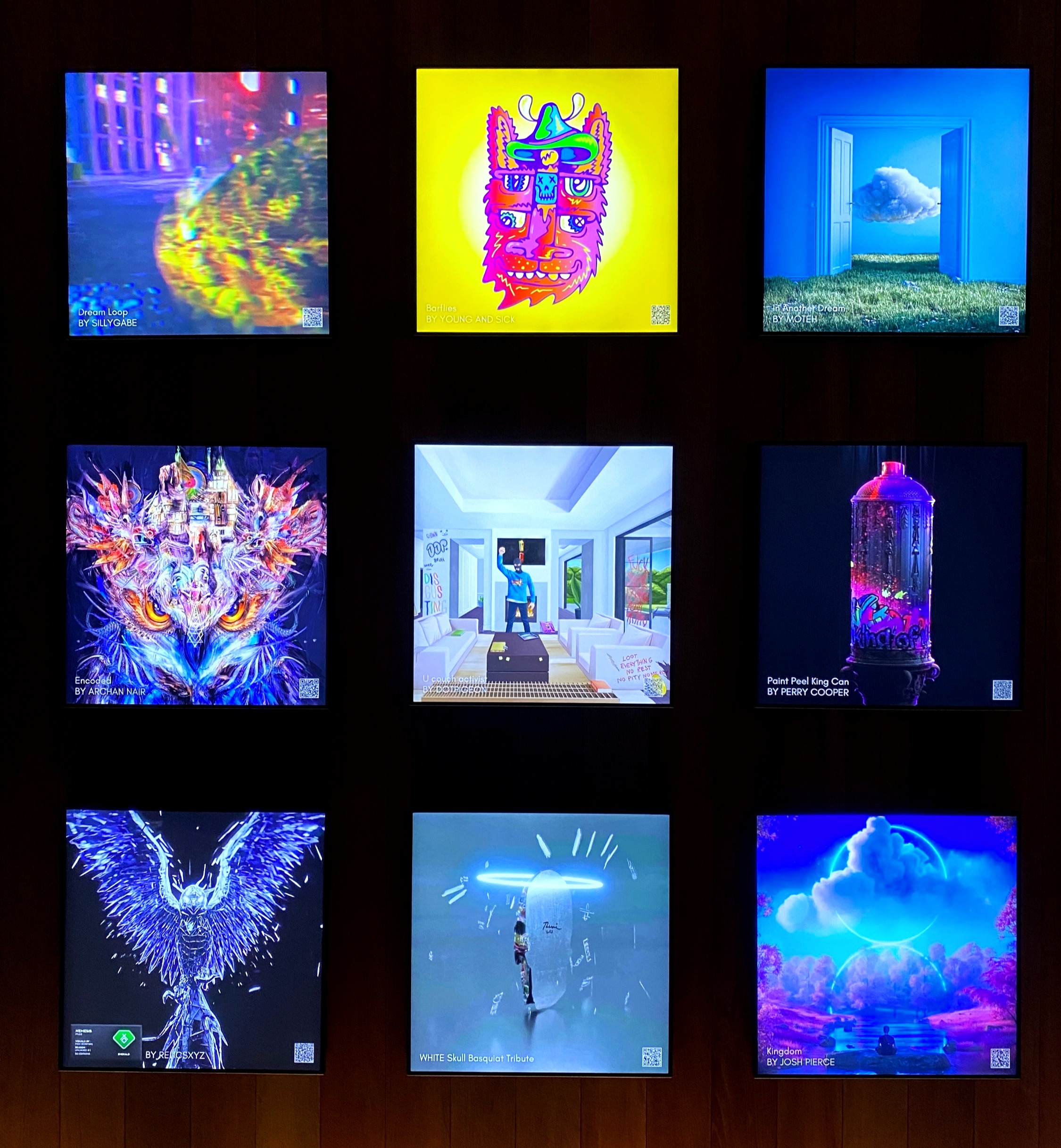
9 square display frames arranged in 3 rows of 3 showing NFT art

There are many digital displays on the market that cater to digital art collectors. But only some of these frames are optimized for blockchain-based art (aka, NFTs). And among that subset, features vary widely from brand to brand. Just some factors to consider when purchasing an NFT display frame are what screen sizes the manufacturer offers; which blockchains they support; whether audio playback is supported; and whether the frame can rotate to best show off portrait- or landscape-oriented images.

As I recently started looking for the perfect frame to showcase my own NFT collection, I found myself overwhelmed by the options. So I began to compile this complete roundup of the state of the digital display market going into 2024 to help other collectors navigate the numerous options and find the perfect frame for them.

My picks are based on my own extensive research into each brand’s product offerings. As you will see, my assessments are honest and sometimes idiosyncratic. For some brands below, I have included a purchase link that will automatically return a percentage of the sale to me. If you choose to buy a frame, please consider supporting my work by using a purchase link in this article.

And now on to the good stuff: Here are my picks for the best displays on the market for NFT collectors.

Best Overall NFT Frame: The Muse Frame
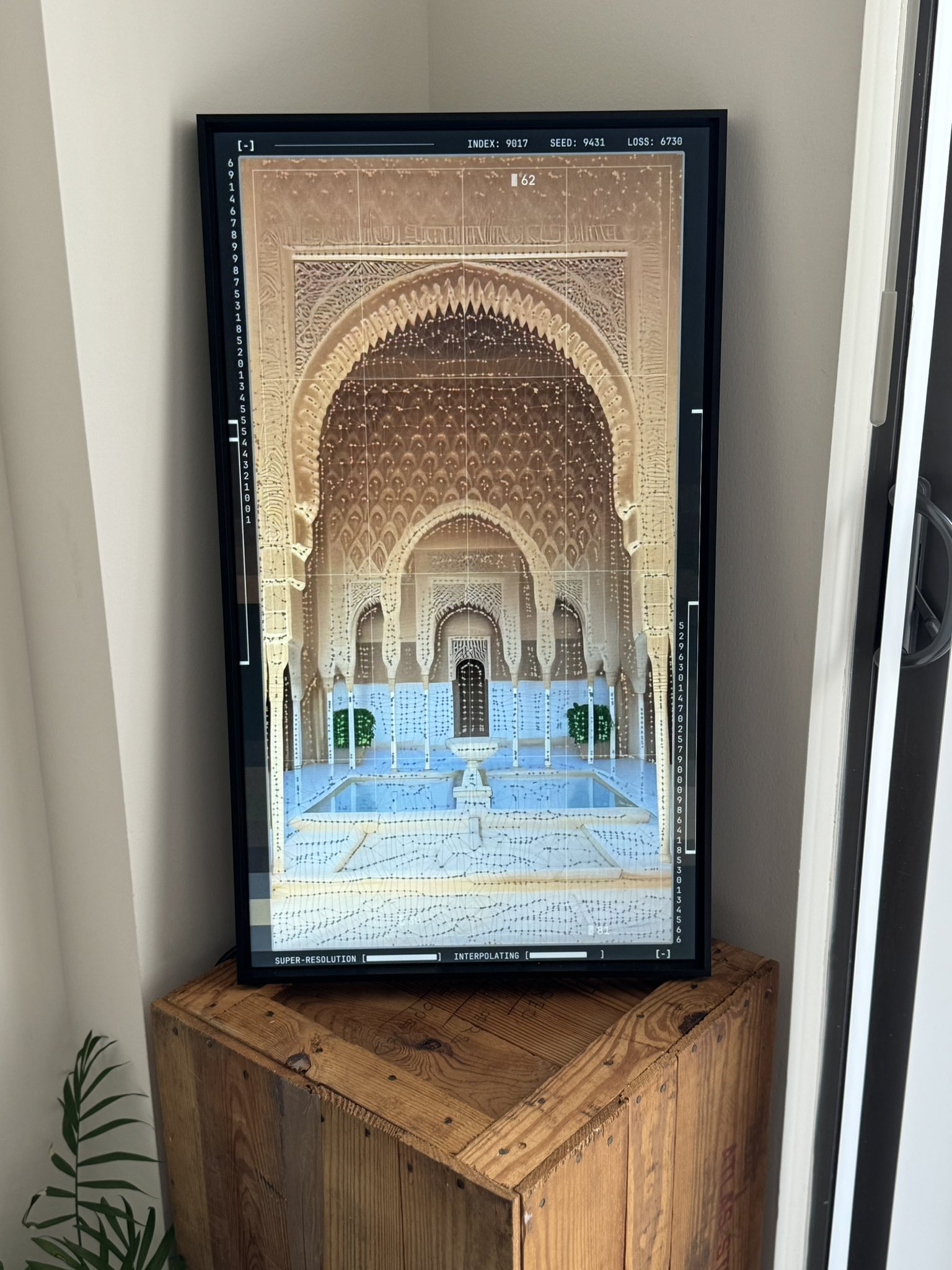
A Muse frame in portrait mode showing a picture of Islamic architecture

Out of all the products on the market right now, the Muse Frame has the most to offer NFT collectors.

The Muse frame offers a range of frame sizes (even as small as 10″), all at reasonable prices. It beats out competitors because of its smooth interface, ease of use, and flexibility in displaying different types of artwork (including NFTs, personal photos, and art from subscription services). Plus, I found the company to be extremely responsive, and even receptive to criticism, as I researched this article.

Between the best overall user experience and the most flexible product, you really can’t go wrong with a Muse frame.

Use my affiliate link to make your purchase and support my writing: Shop Muse Frames

Best NFT Frame for Hardcore Collectors: TokenFrame

UPDATE NOVEMBER 19, 2024: I no longer recommend TokenFrame displays.

The TokenFrame software that comes pre-loaded with their displays has not worked for at least 3 weeks, as the company has run out of money. While it is possible for existing customers to use workarounds to display NFTs on TokenFrames, and the company is exploring subscription-based options to fund the TokenFrame software, I do not advise purchasing a TokenFrame display at this time.
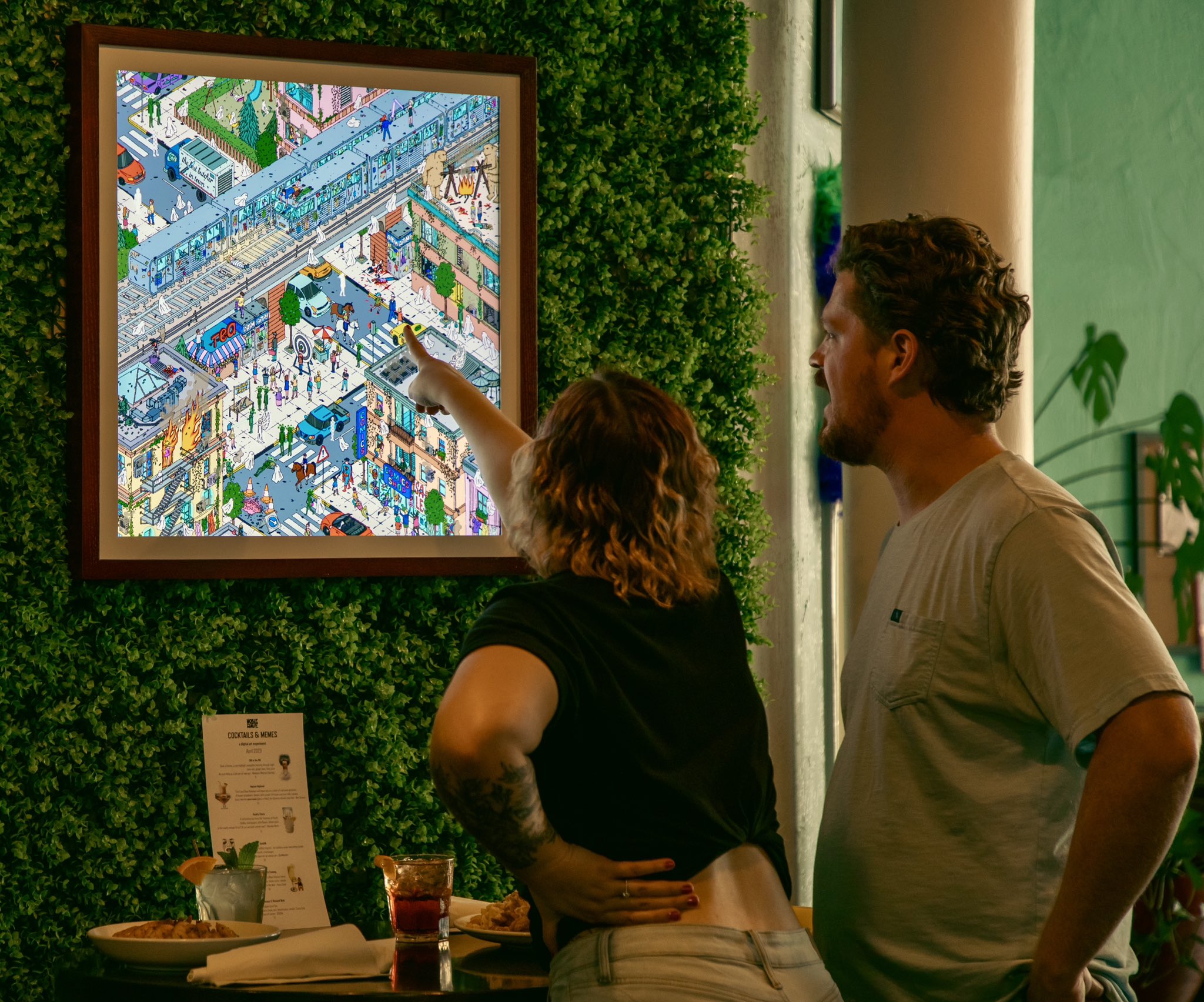
A woman points at a dense, colorful image on a TokenFrame

TokenFrame is the only brand whose product is fully committed to NFTs, in that their frames can only display tokenized art. This strict approach will appeal to users who believe in respecting the authenticity and provenance of digital art: If you see a piece of art on a TokenFrame, you can be sure that the author purchased on the blockchain.

I ended up purchasing a 32″ TokenFrame display during the course of writing this article. I’ve found it to be a beautiful display for my Ethereum-based and Polygon-based NFTs. I appreciate being able to rotate the frame, and having the ability to schedule the frame to turn on and off. TokenFrame’s pricing is reasonable, and I also found them to be responsive to my inquiries for this article.

That being said, the product doesn’t have the smoothest UX, since users can only interact with the screen through the TokenFrame webapp or smartphone app. This requires occasionally having to authenticate before you can take any action with the device, which can be a pain for those who use a hardware wallet to protect their NFT collection.

But for purists committed to a world of blockchain-authenticated art, there is really only one brand out there for you, and that’s TokenFrame.

Best Frame for Nifty Gateway Collectors: The FRAME by Samsung

A Samsung promotional photo for The Frame TV

For those who collect NFTs primarily through Nifty Gateway, Samsung’s competitively priced FRAME TV is the clear choice. With a native app that allows users to display their own Nifty Gateway collection, and even purchase NFTs through their TV, Samsung has built an easy to use platform that follows Nifty Gateway’s lead on making it easy for mainstream users to become NFT collectors.

In addition, the device offers a long list of great features for a digital display, including support for audio and video (naturally), mechanical device rotation (via an add-on mount), plus automatic picture adjustment based on ambient light.

However, this TV does not offer native support for NFTs out there on public blockchains such as Ethereum, so it’s not ideal for all collectors. If you want to show off NFTs you own outside of Nifty Gateway’s ecosystem, you have to rely on apps made for smart TVs. Additionally, the OneConnect box that must be attached precludes this from being used easily as a wall frame.

Still, it is a beautiful display offered at a relatively low price by a major manufacturer with more versatility than any other frame on this list.

The Full Roundup – All the NFT Display Frames

As you may be able to tell by now, each device comes with its own trade-offs. It will be up to you as a collector to figure out what are the key features you need in an NFT display frame, and find the best match among this list.

Here are my full thoughts on each brand, including the ones that didn’t make the cut for my top picks.

Muse Frame

A uniquely versatile option for NFT collectors that can also display non-tokenized images.
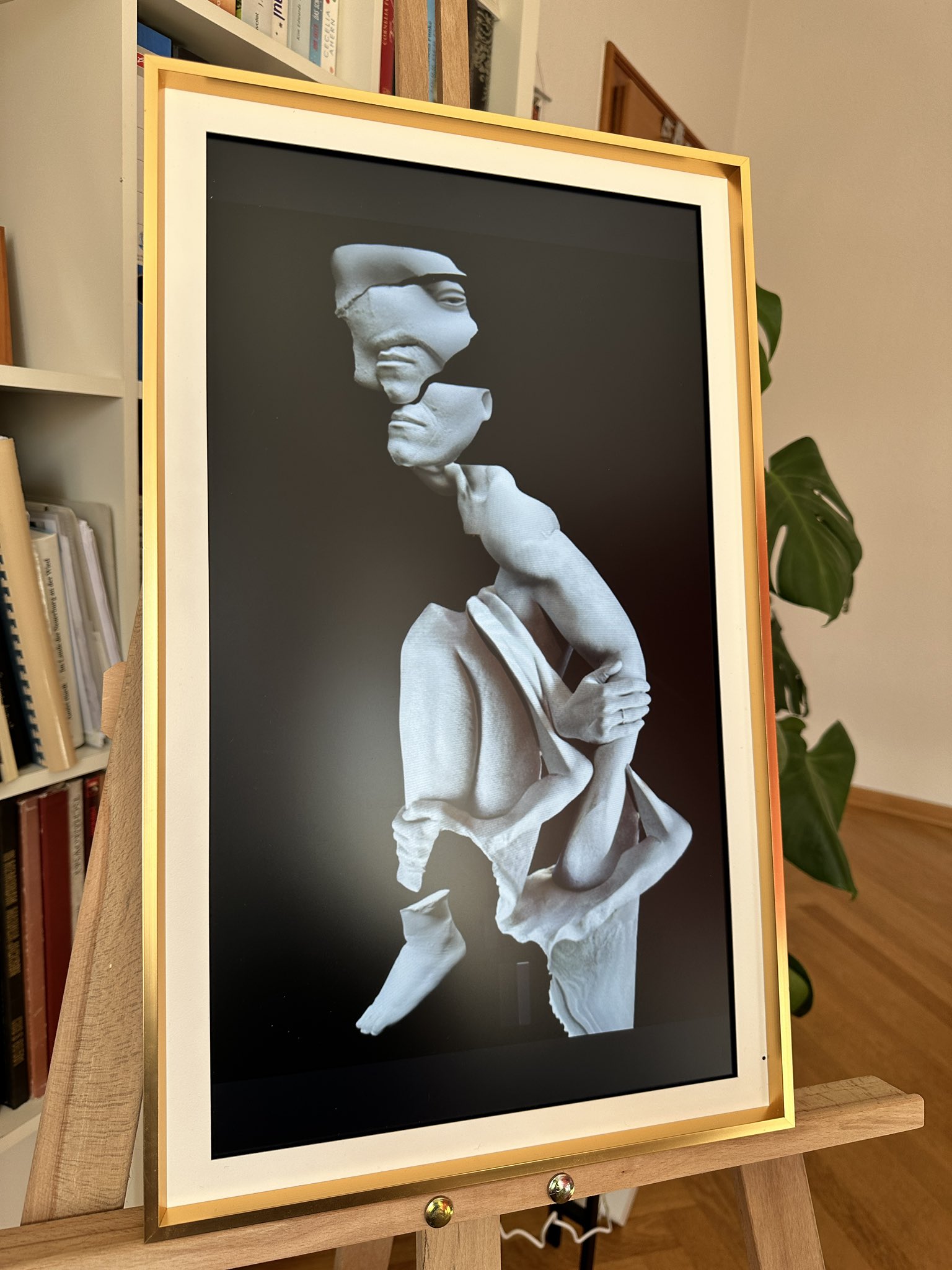
A Muse frame on an easel

The Muse Frame was launched by and for NFT collectors after they found existing solutions lacking. This is a scrappy company with a focus on the hustle, and their determination to build the best solution for crypto art collectors is evident from their hustle to meet the demands of customers. (For this article, the founder of the Muse frame answered my questions extensively and even arranged a remote walkthrough so I could “test drive” the product.)

To start with, Muse frames come in a variety of sizes from very small (a 10″ tabletop display) to large (55″), and even two square sizes. They are generally priced in the middle-high end of the market, in line with competitors like TokenFrame. They run on Android and come with a remote control and 16GB of memory, which can store your NFTs for offline playback.

Muse frames support the Ethereum and Polygon networks via Metamask, Rainbow, and Coinbase wallet logins. While I wish there were support for more blockchains, you are able to access the device’s browser on Muse frames, which means that in theory you can display any NFT through the web interface of your choice. Out of all the companion apps I was able to test, I found that Muse’s companion iPhone app, which lets you select NFTs to cast to the frame, was the easiest to navigate and the most responsive.

Muse frames can be physically rotated to portrait or landscape mode, and you can customize how NFTs display within your that orientation. They include built-in speakers in the rear of the unit. Muse Frames do not support automatic display adjustment based on lighting conditions or a scheduled on/off feature, although they assured me the latter feature is coming soon.

Muse Frames will appeal to a more general audience than something like TokenFrame or Atomic Form since they can support casting of any image from the user’s phone library. In addition, the Muse Frame offers support for an art subscription service (Sedition), so that a user does not have to own NFTs to be able to display a variety of artwork.

Overall, the Muse Frame offers the widest feature set and the most flexibility for NFT collectors. You can’t go wrong with one of these frames.

Use my affiliate link to make your purchase and support my writing: Shop Muse Frames

TokenFrame

Designed for the devout, this strict NFT display is the right choice for those who most value blockchain authentication.
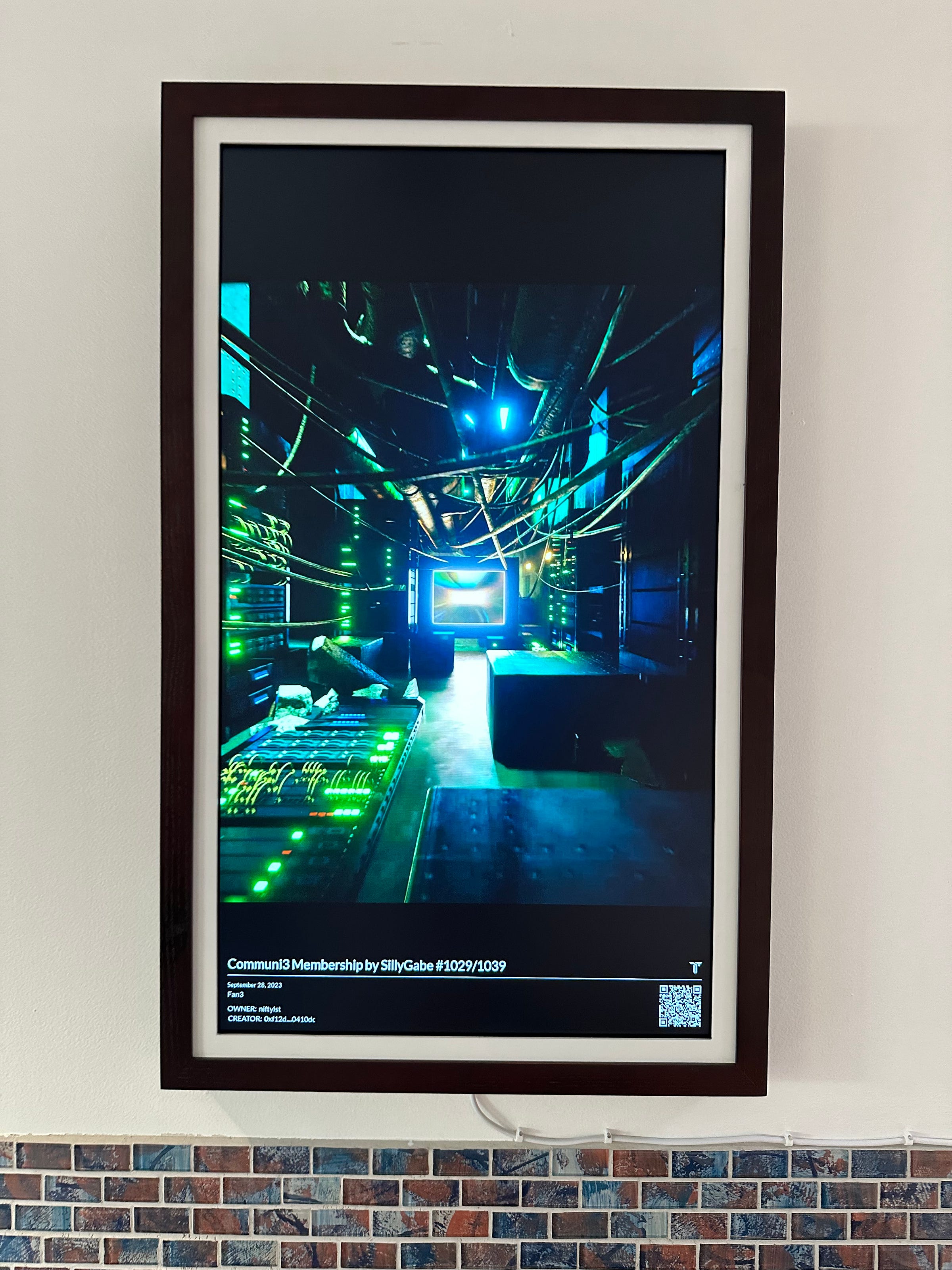
A TokenFrame in portrait mode on a wall

UPDATE NOVEMBER 19, 2024: I no longer recommend TokenFrame displays. 

The TokenFrame software that comes pre-loaded with their displays has not worked for at least 3 weeks, as the company has run out of money. While it is possible for existing customers to use workarounds to display NFTs on TokenFrames, and the company is exploring subscription-based options to fund the TokenFrame software, I do not advise purchasing a TokenFrame display at this time.

From my research, TokenFrame stood out as the company that was most committed to nurturing the specific world of NFT art. While all brands on this list marketed to collectors of crypto art, most other companies also offered features meant to broaden the appeal of their products beyond the limited audience of NFT collectors.

Not TokenFrame. NFT collectors are their audience. That is to say, this product does not have all the features that a digital display frame could have — and that’s what makes it stand out. To be specific, a TokenFrame display will not let you show photos from your phone, or allow you to subscribe to an art curation service. You don’t have access to the browser, or even to any physical settings on the device. It’s there to show off the images you own on the blockchain, and it’s all done through their authenticated web portal.

TokenFrame supports displaying NFTs on the Ethereum, Polygon, and Solana networks via MetaMask, WalletConnect, and Phantom wallets. Promised support for Tezos is still to come. The company also told me they are working on support for Bitcoin Ordinals.

TokenFrame offers a wide variety of frame sizes, including square sizes. Overall, their pricing was on the high end for most models. The 32” model, their most popular model according to a representative, retails for $999. (This was the model I ultimately purchased myself.)

TokenFrames come with a rotating mount. When rotated, the display will update automatically to match the new orientation. The frames include speakers, but they are not good, with no bass response to speak of.

Getting my TokenFrame set up was a bit of a chore, since the locked-down device requires you to connect it to wifi via your phone. But once set up, I found the frame to be zippy and responsive. The TokenFrame webapp is a better software experience than most, although there is room for improvement in terms of responsiveness.

Overall, I felt that TokenFrame was the best choice for committed NFT collectors. If you worry that allowing non-tokenized images onto an NFT display frame raises thorny questions of authenticity, then TokenFrame is the choice for you.

Atomic Form

A premium offering, especially useful for Nifty Gateway collectors, whose feature list may not justify its price point.
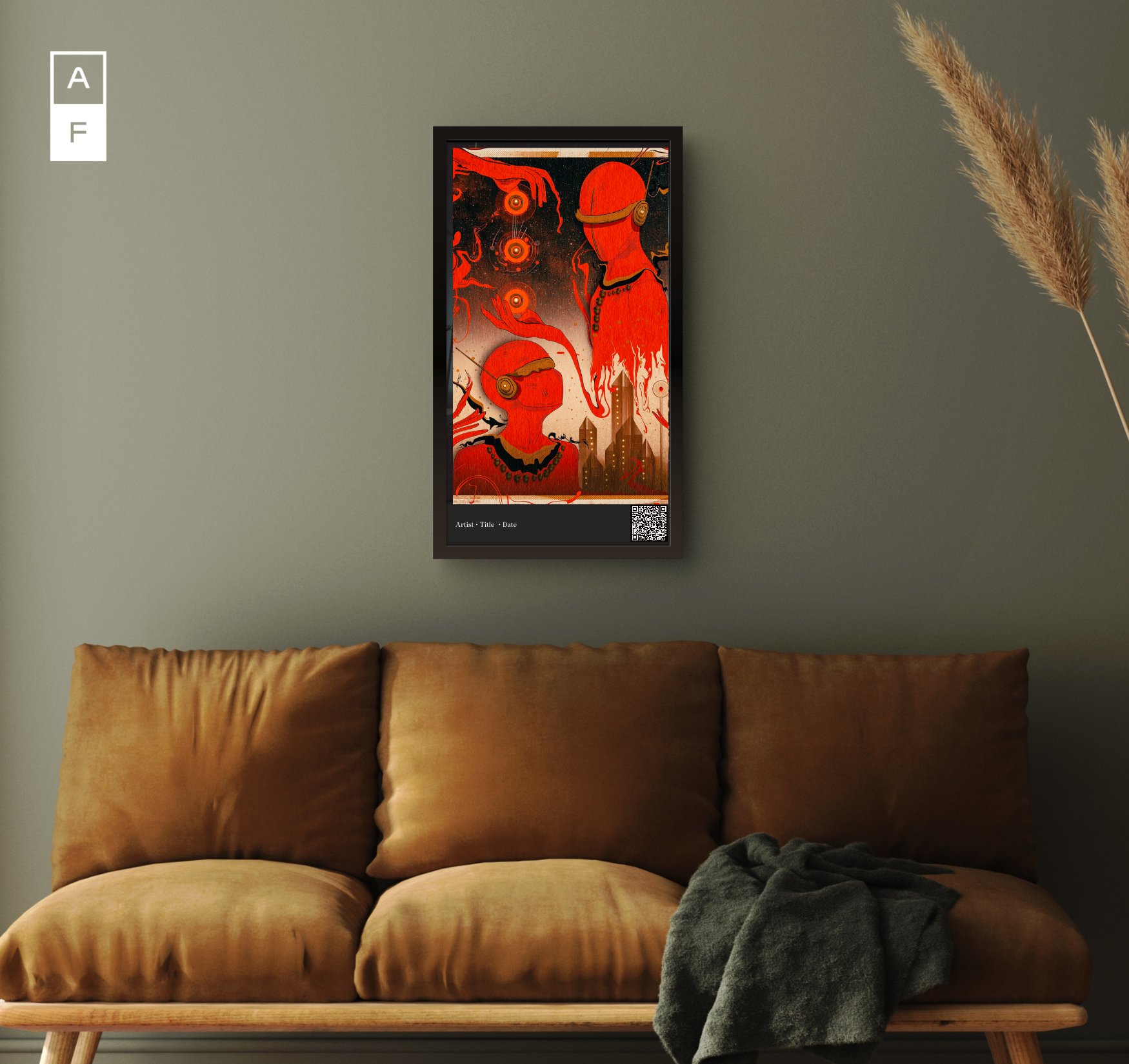
An Atomic Form promotional photo for the Wave device

Atomic Form offers single-size frame for experienced NFT collectors called the Wave. There are three things to know about this offering.

First, the Wave only comes in one display size — a 27” 4k display (comparable in size to many desktop display monitors).

Second, the Wave is priced very high, at $1,500. For comparison, the only other company offering a 27” frame is Meural, whose Canvas product lists at $699 — less than half the cost of an Atomic Form display. Consider also that TokenFrame’s larger 32” display costs $999. Atomic Form is clearly out of step with their competitors in this size range.

Third, Atomic Form is one of only two displays that integrates with Nifty Gateway. This is good news for collectors on that platform, since it means you can just log in to your Nifty Gateway account to display your NFTs. For most other displays on this list, Nifty Gateway users would be forced to transfer each NFT they want to display to an external wallet, which is potentially expensive depending on Ethereum gas prices, not to mention a major pain in the butt (let me tell you!).

Apart from the connection to Nifty Gateway’s closed ecosystem, Atomic Form supports Ethereum and Solana through Metamask and Phantom wallets. (It was not clear if it supported any layer 2 networks such as Polygon.)

The Wave display frame can be rotated to display NFTs in portrait or landscape mode. It does not seem to support direct audio output, although it can connect to an output device through Bluetooth. Unique among competitors, the Wave can be purchased in ETH (always equal to an approximate price of $,1500 USD).

I was not able to test a Wave frame, but I was able to log into Atomic Form’s webapp, which I found to be basic and clunky. Several of my Nifty Gateway NFTs showed up as broken image icons. (For what it’s worth, Duncan Cock Foster, one of the Co-Founders of Nifty Gateway, told me that he loves his Atomic Form display.)

Apart from their Wave frame, Atomic Form offers a product called Photon that allows you to display your NFTs on any display via HDMI. So if you have the perfect display in mind and want to find an easy (and portable) way to show off your Ethereum-based, Solana-based, or Nifty Gateway-based NFT collections, that may be your best option.

Ultimately, I could not find enough standout features that justified the large premium this company charges for their flagship Wave frame. Still, for Nifty Gateway collectors who are not sensitive to price, Atomic Frame could be a fine choice.

Samsung “The Frame”

A thin TV from a major brand that can display NFTs and other art, but whose external box limits where it can be placed.

A Samsung promotional photo for the Frame TV

Samsung’s “The Frame” stands out on this list as a bit of an odd fit. It is one of two options that are made by large corporations instead of indie startups. The product is sometimes called “The Frame TV,” because in fact, it is a fully functioning TV. However, it has been marketed at digital art collectors because of its slim profile and included picture frame with customizable bezels. And indeed, this product does have a number of features which are compelling for NFT collectors.

But let’s start with the one weird thing about this product (other than the fact that it can play TV shows): In order to get such a slim profile, Samsung moved some of the functions of a typical TV to a physical box called the One Connect box. The box serves as a hub for all connections to the TV, including power and HDMI, coaxial, ethernet, and USB. It must be connected to the TV in order for it to work.

Now, all devices on this list call for at least one cord — typically just a power cord — and many companies acknowledge that this is an aesthetic challenge for digital displays vs. analog frames. So in one sense, the One Connect Box is an improvement, in that it allows any connections to the device to take place well away from the screen, keeping the one power cord in place.

But this also means that the One Connect Box must have a surface to sit on top of, and this will limit where the display can be placed in the home. If you’re going to hang the frame above the mantle, great! If you’re looking for a TV that can also display your digital art, fantastic! But if you’re hoping to hang this in the hallway, you’ve now got a bit of an awkward problem.

Now, let’s review what The Frame offers digital art collectors. The Frame offers a large variety of screen sizes, starting at 32” (typical for a digital frame but small for a TV) to 86” (enormous). There are three customizable bezel upgrades (brown, teak, and white) that can be easily added over the default black. The various Frame sizes were consistently priced on the low end of the market — which is impressive considering how many features this product offers. But adding custom frames, or adding on a One Invisible Connection cable, will add some cost.

The Frame supports audio playback (naturally, being a TV), as well as rotation of the Frame (not so naturally for a TV!). Notably, itseems to support automatic dimming based on lighting conditions.

In terms of support for NFTs, the Frame is uniquely mixed. The Samsung NFT Platform app comes pre-installed on the device, and is powered by Nifty Gateway. This is fantastic for Nifty Gateway collectors, who are otherwise short-changed by most other brands on this list. Samsung NFT Platform users can even purchase NFTs directly through their TV to display.

The Nifty Gateway integration also features a neat solution for the problem of a user displaying art that they haven’t purchased. The screen can seemingly show any NFT on Nifty Gateway — but if the user doesn’t own it, a Nifty Gateway logo will be superimposed on a corner of the screen.

Unfortunately, the Samsung NFT Platform does not support wallet login for any blockchain — which means no Metamask login and no out-of-the-box support for even your Ethereum-based NFTs. I find this rather shocking for a device marketed to NFT collectors. Instead, you have to rely on third party apps in their ecosystem to cast your NFTs, which may or may not support your preferred blockchain. Presumably, though, you could access the device’s browser and show off your NFTs that way.

If all else fails, you have the option of downloading the media files from your NFTs and casting them to the screen from your phone (which is bound to be a major pain no matter what platform you’re using).

For the larger displays (43″-65″), a separate auto-rotating wall-mount is available that will mechanically rotate your display to portrait or landscape orientation. This is supposed to integrate with the NFT Platform app to rotate your TV to display NFTs in landscape mode.

Overall, I was surprised to find such a strong contender for an NFT frame from a major manufacturer. While the lack of native support for NFTs on any public blockchain is unfortunate, Nifty Gateway users at least will find a smooth solution for displaying their collections without having to move their NFTs off the platform.

Canvia

A budget offering for art lovers who might own some NFTs on Ethereum.
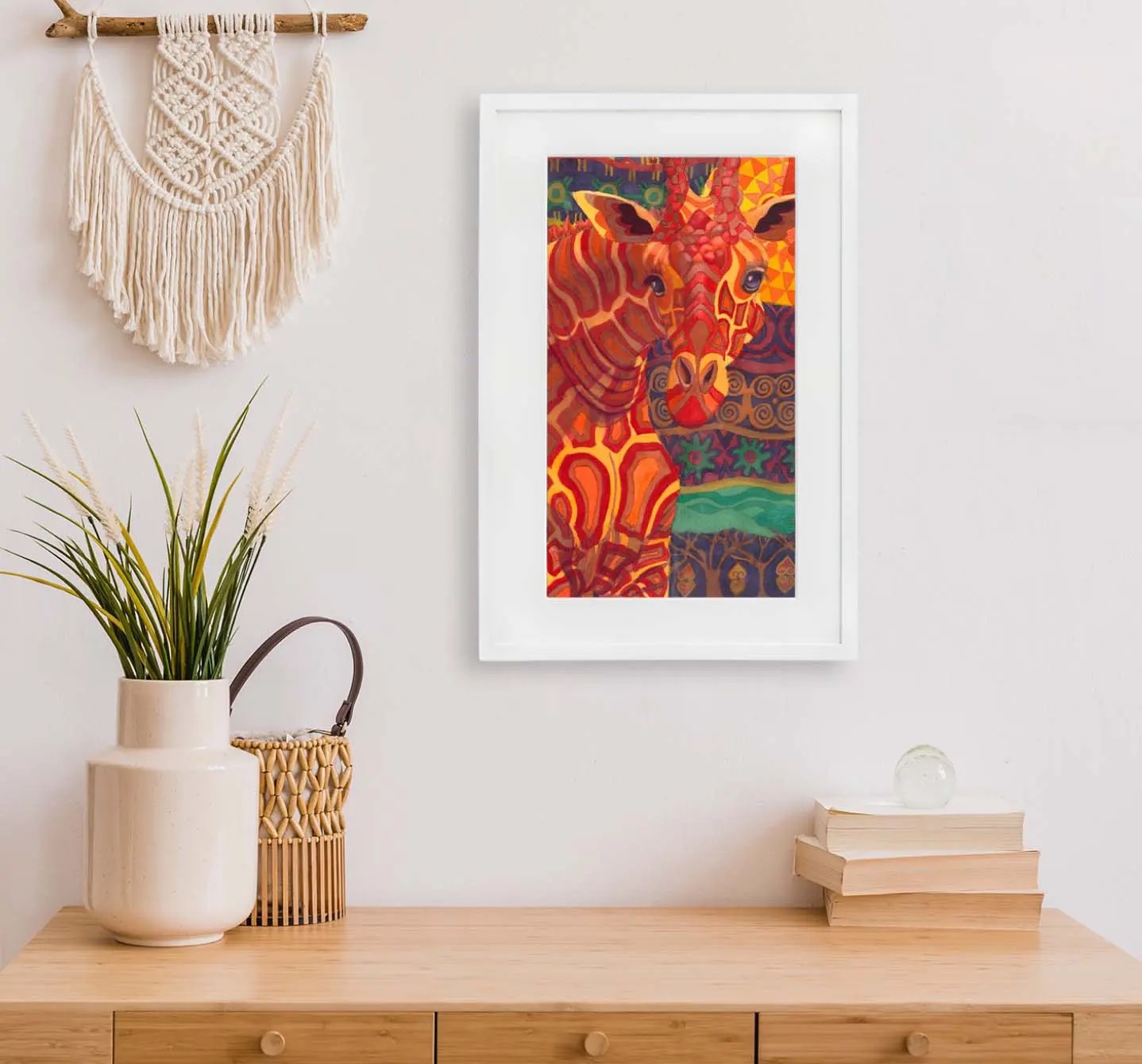
A Canvia promotional photo for the Canvia Digital Canvas

The Canvia Digital Art Canvas is aimed at traditional art collectors who value a high-quality display at a low price point. It is a smaller display frame available in only one size (27”). It is priced on the budget side, at $521.

But the Canvia canvas offers only limited support for crypto art. Canvia allows for logging in with Metamask to display NFTs. Unfortunately, this seems to be the only wallet they support, and it was not clear whether they support any Ethereum L2 blockchains such as Polygon.

On the other hand, this device supports the casting of personal pictures via user uploads or login via Google Photos, a great feature for many consumers who may not be into NFT collecting. Canvia also offers an art service subscription, so the user doesn’t need to own an NFT to display art. Additionally, the company partners with digital artists to display their art. (The pricing of these services were not clear to me.)

One nice feature is that Canvia does automatically dim according to the ambient light. But Canvia does not support rotation of the frame, and does not have native audio playback, two features that some NFT collectors will miss.

I was able to test Canvia’s web interface, which I found smooth, although I encountered an error when trying to login with Metamask.

Buyers will want to make sure they are comfortable with the large white matte surrounding the screen. It certainly helps position the content as art, mimicking a traditional way to display photos or paintings in a physical frame. But it also limits the size of the art, and options for displaying different aspect ratios.

Given the frame’s limited support for wallet login and apparent lack of support for any blockchains besides Ethereum, Canvia seems like a better option for those looking for a general market digital display frame than dedicated NFT collectors.

MetaSill

A good-looking option for displaying NFTs.
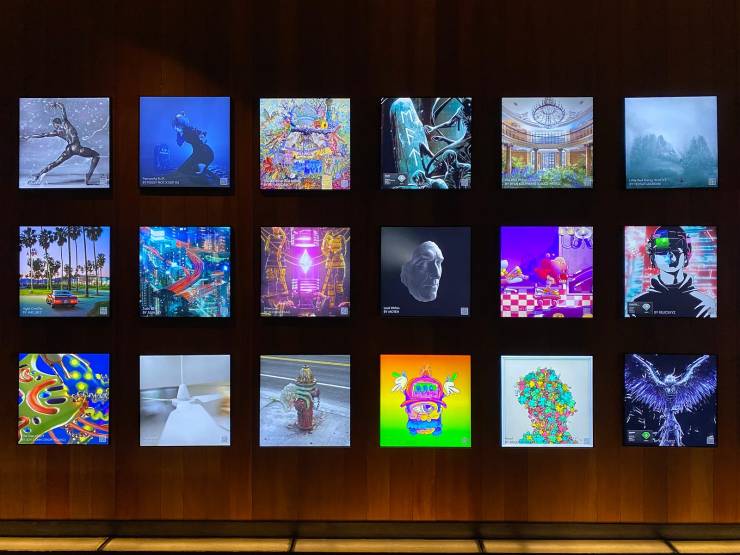
MetaSill square frames at the Crypt Gallery in NYC. (Author Photo.)

MetaSill NFT frames are a mid-market offering that come in a variety of sizes, including squares, from a 10″ frame all the way up to a 75″ frame.

The MetaSill stands out for me as the backbone of the Crypt Gallery in Manhattan, which features a truly formidable amount of displays on the wall of the lobby of the Dream Hotel. They at least look fantastic.

MetaSill allows login via Metamask and Phantom, supporting Ethereum and presumably Solana. I was able to set up an account on their web portal easily, but I was not able to test casting or display options to a screen.

MetaSill NFT are missing some of the premium features that define the higher end of the market, in that they do not support audio playback, automatic dimming, or screen rotation (at least that I could find mention of). They do not offer an integration with a subscription art service, or platforms like Nifty Gateway.

The company has a less polished web presence that seems to be focused more on offering rentals than purchases. I found that some of the links on their website were dead, and the company did not respond to my inquiry.

If all you need is a great-looking screen to display your NFTs, MetaSill frames (at least the smaller sizes), should be a good option for the price.

Use my affiliate link to make your purchase and support my writing: Shop MetaSill Frames

Meural Canvas

A workable offering from a large brand, but whose user experience is lacking.
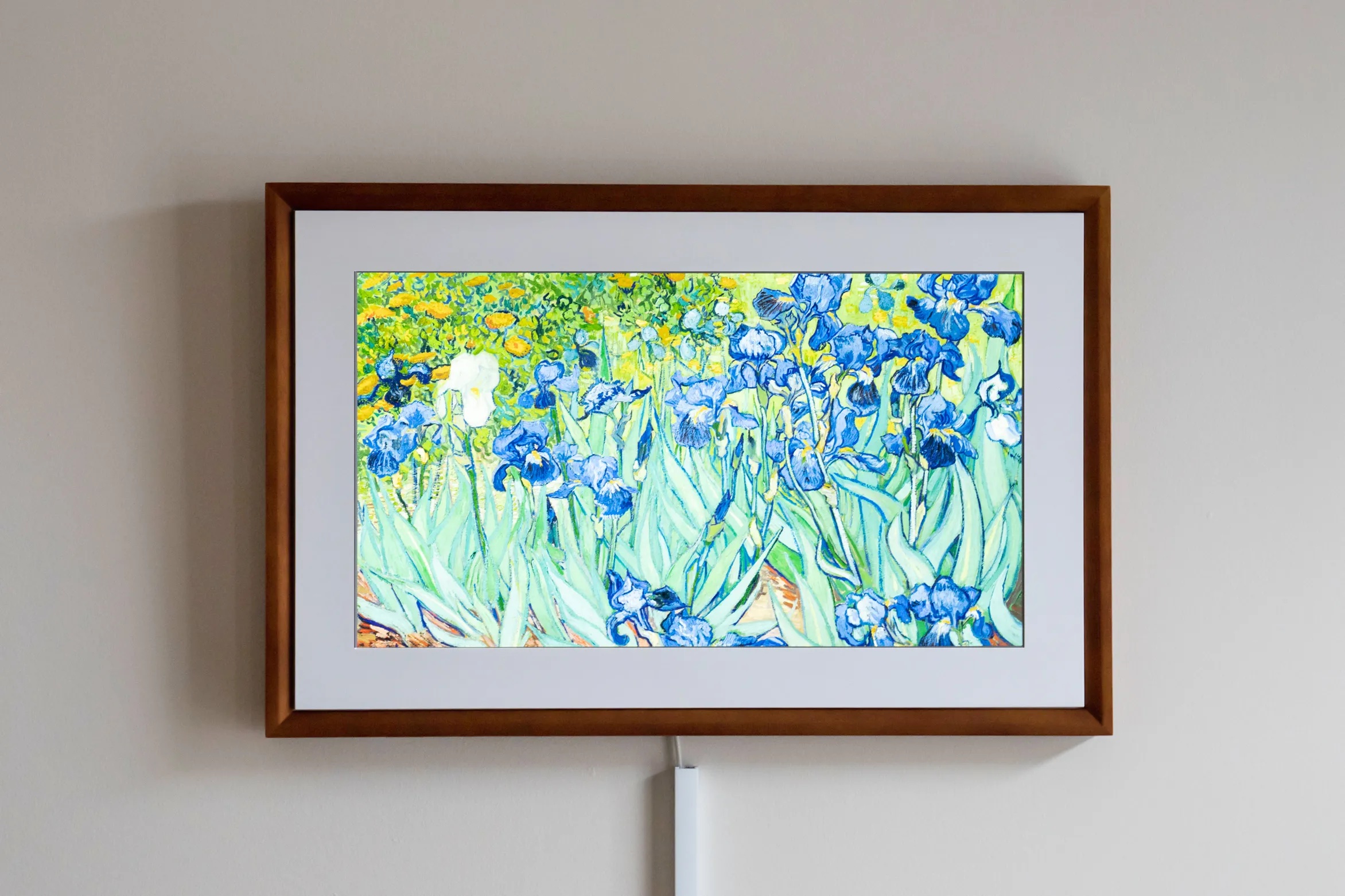
A Meural Canvas frame. Photo: TechCrunch

The other big brand competing for NFT collectors’ dollars is NetGear with their Meural line of digital frames. The company offers three options: The Meural 13.5″x7.5″ Frame (not called Canvas), with a 15.6″ diagonal; the Meural 16″x24″ Canvas, which sports a 21.5″ diagonal; and the Meural 19”x29” Canvas, which has a 27″ diagonal.

Like the Canvia Canvas, Meural frames are marketed to NFT collectors as one category of digital art collectors. It seems like Meural’s main demographics are users looking to showcase their personal photos, or who want to show off art from a free curation service or optional subscription service. Consequently, their support for NFTs is limited.

Meural supports Ethereum and Solana NFTs via MetaMask, Coinbase, and Phantom wallet logins. Their webapp allows you to collect multiple wallets at once, so you can select which NFTs from your various wallets you want to display. There is a companion mobile app as well.

The Meural hardware includes a light sensor that automatically adjusts the lighting of the frame according to room lighting, and will even turn off the frame when the lights go out (a favorite feature of mine).

Though a feature called the Meural Art Service, users are able to select art to display on their Canvas. Though it is a subscription service, it includes a decent selection of art that can be displayed for free.

Oddly, the Meural Art Service has partnerships with the NFT platforms SuperRare and Async Art that allow users to display works from those platforms, even if they don’t own the NFTs. When I checked, there were a few dozen pieces from each website that were available even for free users to display. (Given Async Art’s recent announcement that they will be shutting down, I wonder if this integration will continue to be supported.)

I own a Meural 13.5”x7.5” frame, so this is one of the devices I can speak to with the most experience. This particular frame, the smallest of the three offerings from Netgear, is made to be placed on a surface instead of hung on a wall. It comes with a built-in stand that allows it to be be placed in portrait or landscape mode.

Overall, I’m lukewarm on this product. My initial experience was bogged down by the poor UX of their mobile app and lack of support for Tezos. This forced me to have to download the files associated with my Tezos NFTs and cast them to the display one by one — an arduous process. (Note: I have not found any display frame that supports Tezos NFTs.)

But once I got my favorite NFTs on the device, and once I got the hang of casting to it, I have come to appreciate it more. I enjoy seeing my collection rotating through this screen all day long, and turn off when the lights do.

My biggest remaining complaint (besides lack of Tezos support) is the quirky user interface on the device itself. Instead of including a remote, Netgear developed a gesture interface that requires you to wave your hand in different directions in front of the device to navigate the menu. Unfortunately, I have never gotten the hang of this control method, and I would say solidly less than 30% of my gestures are successful in getting the device to do what I want.

Overall, the Meural is a good device for NFT collectors who want to show off their Ethereum or Solana NFTs alongside other images at a reasonable price. Just be prepared to struggle your way through the gesture controls as you set it up.

BlackDove

An NFT display from an innovative company, held back by a mandatory subscription.
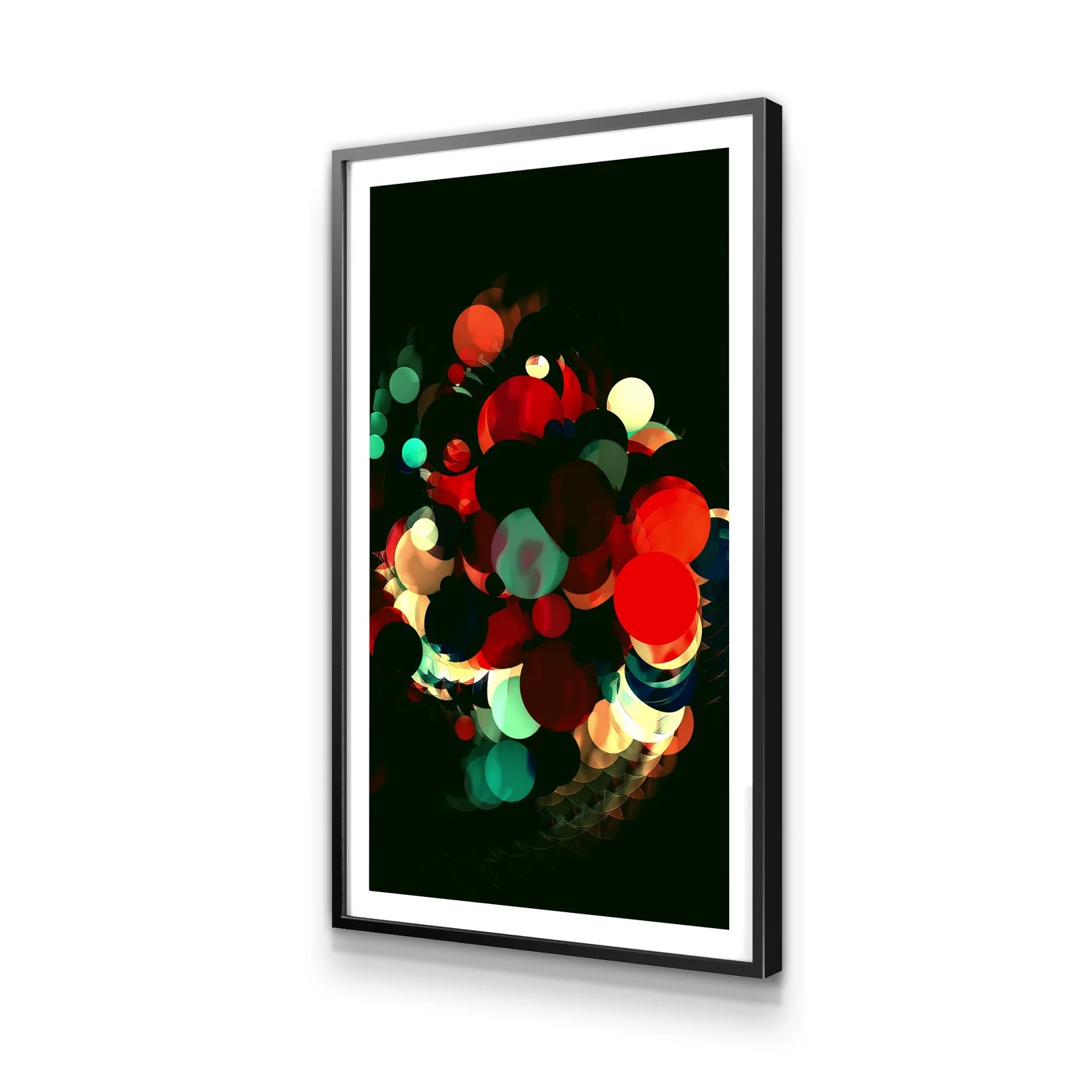
A BlackDove frame. Photo: BlackDove

BlackDove has historically targeted the higher end of the NFT display market with screen sizes ranging from 43″ all the way to 98″ (!). But as I write this, they are taking preorders for smaller frame sizes that compete with the other brands mentioned in this article, including a 21.5″ and a 32″ display, as well as two square sizes of 22″ and 33″. The pricing for these new frames is right in line with competitors at those sizes.

BlackDove frames support Ethereum based NFTs through MetaMask and WalletConnect logins. It was not clear whether they support any other blockchains.

The BlackDove frames offer audio playback, and come with a remote control. The frames do not support rotation.

While I did not have access to a BlackDove device, I was able to log into their webapp using Metamask. I found the software experience passable, if not exactly pleasant.

The major downside of BlackDove’s offerings is that you have to use their app to display your NFTs, and you have to pay a monthly fee of at least $20/month to use the app — apparently even if you’ve bought their hardware. (I sure hope I’m misunderstanding, but the company did not respond to my inquiries requesting clarification.)

With apologies to Blackdove, I struggle to imagine why anyone would buy a NFT display device that’s going to lose that ability as soon as you let your monthly subscription lapse.

It’s not all bad news here, though. I was impressed that BlackDove allows users to buy NFTs directly through their webapp.

And BlackDove was the only company I found that offered the ability for buyers to purchase display licenses for artworks. This is a novel solution for showcasing art on a digital frame, and one that sidesteps thorny blockchain issues of image hosting and user authentication. I can easily see consumers wondering why they’d bother with all the fuss of NFTs (including having to acquire crypto, purchase and transfer the artwork, then log in through a display app), when they could just buy a license with cash and have the artwork show up right away.

Overall, I’m put off by BlackDove’s insistence on charging users a monthly fee to use a BlackDove display. And for a company focused on NFT art, I am surprised their support for blockchain networks appears to be limited to Ethereum. Otherwise, though, the company seems to be developing some innovative approaches to displaying NFTs, which is refreshing to see in a time when some of their competitors’ focus on crypto art seems to have waned.

Infinite Objects

A great option for a desktop frame permanently dedicated to showcasing a single NFT.
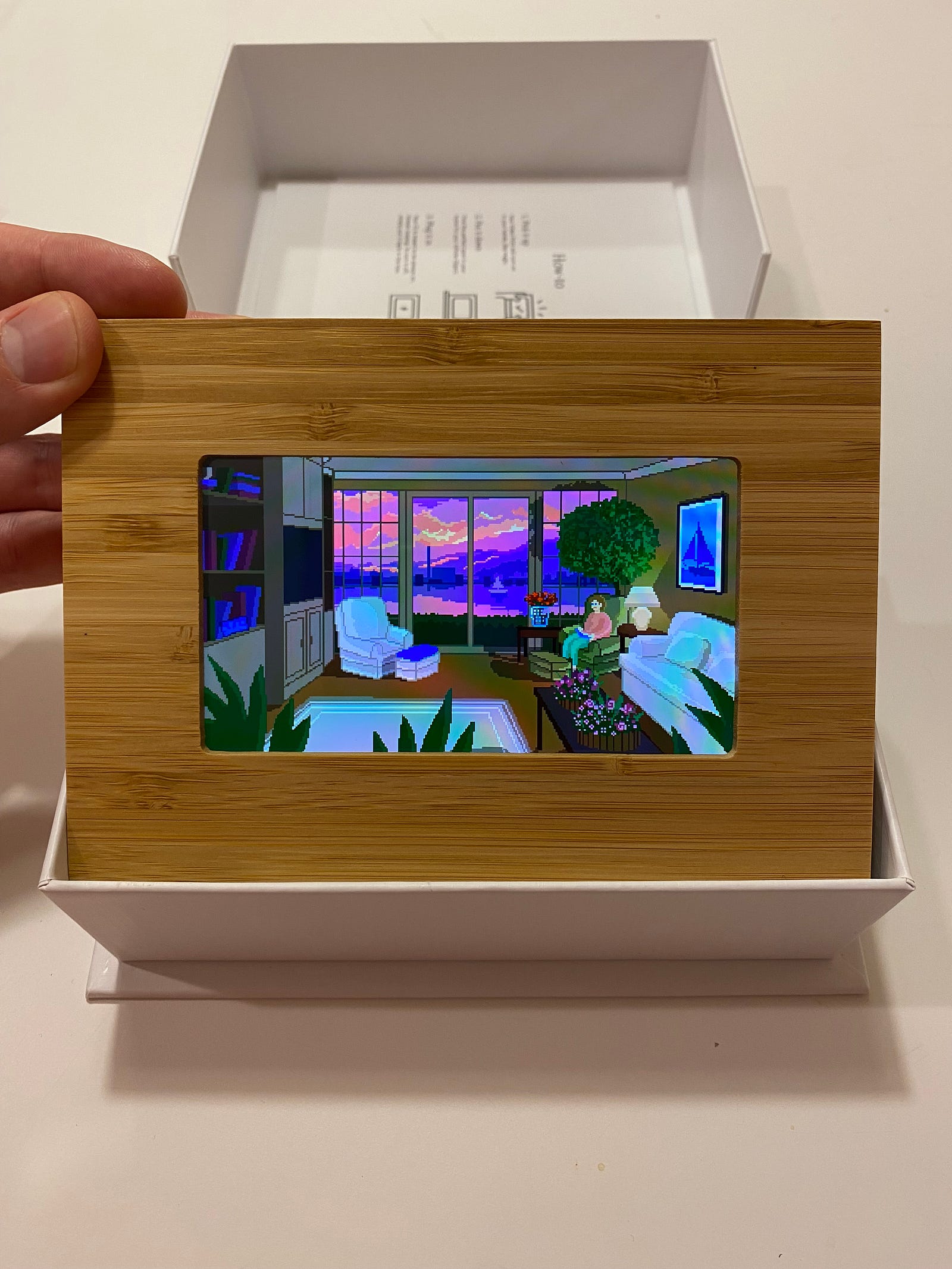
An Infinte Objects frame being unboxed. (Author photo.)

Infinite Objects is unique among display options in that these displays can only display one video ever. They call it a “video print” — a permanent, looping playback of a single file.

Infinite Objects only offers small devices — tabletop options ranging from 5″ (about the size of a playing card) to 10″ (about the size of a sheet of paper). They come with bamboo or clear acrylic frames.

Despite their small size, they must be connected to power at all times. These displays are not capable of sound playback. The screens do not turn off automatically, nor adjust to lighting conditions.

I think Infinite Objects may work best as a gift. For example, with the help of the artist Anas Abdin, I was able to gift my brother a custom portrait of our grandmother after she passed. He was touched and delighted by the video print, and the company does a great job building a memorable unboxing experience.

Infinite Objects is committed to the web 3 ethos. They will only print NFTs whose creators have authorized them to be printed. However, you may also upload your own video to Infinite Objects, and forego the blockchain route altogether.

Therefore, this option is best for collectors who are attached to a single NFT or artist who has authorized their work to be printed via Infinite Objects displays.

Frames that Folded

In case it helps anyone else attempting a round-up of all the NFT displays on the market , I’ve also compiled a list of NFT displays that I saw recommended in the course of my research which seem to have gone out of business:

FRAMED Mono X7 Digital Canvas

Conclusion

I hope this has helped you evaluate the options for NFT displays out there. I’d love to hear your feedback if you own one of these devices yourself — find me on your social network of choice at @niftyist.
How to Send NFTs by Email (Yes, Really!) Using Kukai

A free wallet client on the Tezos network allows you to send NFTs to emails or even social media accounts – making it possible to gift NFTs to people who have never set up a crypto wallet.

Last year, I decided I wanted gift my friends NFTs for the holidays. Almost none of my friends are into NFTs, and I thought this would be a fun way to get them curious about the technology. So I asked on Instagram for people to just say the word, and I’d send them an NFT.

But I faced a delivery problem: Since my friends weren’t already into NFTs, they didn’t have wallets. How could I gift them NFTs, if I couldn’t actually send them through the blockchain? So I wondered: Was it possible to buy an NFT for a friend, and then email it to them?

A dark elf with a glowing flower

After much searching, it turned out the answer was yes. I found that the Kukai wallet, which I was already using, had added support for an amazing feature (called DirectAuth) that lets users associate their wallets with social media accounts – meaning you could send NFTs to Google, Twitter, or Reddit accounts, or email addresses, and have the user retrieve them using the free Kukai wallet app!

Kukai is a wallet client for the Tezos network. Tezos is an energy-friendly blockchain with a robust NFT market. I had already done plenty of NFT collecting on Tezos, so I was excited to find this solution on a network I was already familiar with.

Now, I should say that Tezos is not as well-known as other blockchain networks, and is not the first blockchain that comes to mind for people who trade NFTs. (That distinction would probably go to Ethereum or Polygon.) But since my friends who would be receiving the NFTs also had no prior knowledge of the NFT space, they weren’t going to care what network their digital collectibles were minted on. So for me, again, this was a great solution.

(And I’ll say at the top – this is not an ad for Kukai. It’s simply the only wallet I have been able to find – after searching many times – that easily supports this feature. And at the moment, I am not aware of any wallet clients on the more popular Ethereum and Polygon chains that support a similar mechanism – although I would love to find any such services and give them a spin.)

Once I found this feature, I was able to send my friends NFTs for Christmas with no trouble at all. And I actually found it a really fun and gratifying experience to send indie artwork to friends that would care about it. So, I’ve written up this guide to help anyone else in a similar situation be able to send NFTs to their own friends!

Step 1: Create your wallet

First, you’ll need to sign up for a Kukai wallet. Now, you have two choices for how do to this.

Option A: traditional wallet setup (Best for security and the crypto-fluent)

Instructions for this method can be found here. This method is the traditional way to set up a new wallet in crypto-land, and is the recommended method for best security and independence from web 2 platforms (i.e. decentralization).

If you’ve never created a crypto wallet before, it’s a bit more involved than creating an account on a typical website. It should take 5-10 minutes, and you will be given a phrase that you need to write down and keep, in addition to setting a password. Make sure you save and retain this phrase in a safe place, or you will lose access to your wallet forever, and no one can help you. (That’s crypto, baby.) Got that?

Option B: Social sign-in (Best for speed and simplicity)

As you’ll see below, one of the killer features of Kukai is its support for signing in through social media accounts. This is the simpler setup and best for novice users. Coincidentally, it’s how your recipients will be signing up for Kukai.

To set up your wallet this way, go to the Kukai website and look for “Sign in with social”. Then select the account of choice that you want to use to access your wallet (Google, Twitter, Reddit, or Email), and proceed through the prompts until your wallet is set up.

I should say, I have not tested this method myself, but it should work similarly to Option A, without the extra step of you having to make a permanent copy of your seed phrase to retain access to your account.

Step 2: Buy some crypto

In order to interact with a blockchain network, you need some of its native currency to pay the network fees each time you transact. So you’re going to need enough crypto to cover the cost of the NFTs you purchase, plus a little extra to cover network fees (aka “gas“).

In our case, we’re using the Tezos network, so you will need to have some of the native currency Tez (ticker: $XTZ) on hand to fund the transaction. $1 worth of Tez should be more than enough to cover your gas on Tezos for awhile.

You can purchase many cryptocurrencies, including Tez, at exchanges such as Coinbase or Gemini. (If you’ve never signed up for an exchange before, it can take at least one business day to get through their KYC processes, so make sure you plan for that delay.)

Step 3: Fund your wallet

Once you’ve purchased your crypto on an exchange, you need to move it from the exchange’s custody into your own wallet. Think of it as withdrawing your cash from the bank.

In your crypto exchange, find the way to withdraw your funds. Here you will have to put in your wallet’s unique address to receive the funds. Use this “Copy Address” button in the top right corner of your Kukai wallet to get your address. (My Tezos address is niftyist.tez because I purchased that address through Tezos Domains. Your Tezos address should look something like “tz1XRnq…”. )

Next, paste that wallet address into the withdrawal form in your exchange. Finally, input the amount of Tez you want to transfer to your wallet, and transfer the crypto to your wallet.

(Tip: It’s always good to do a test transaction with a small value the first time you try to transfer to your wallet, just to make sure it works. Once you’ve successfully received the funds in your Kukai wallet, you can do a second transfer with the remaining balance.)

Step 4: Find the NFTs you want (the fun part!)

Now that you’ve funded your Kukai wallet with Tez, you will be able to make some outbound transactions from it. That means you’re ready to go shopping! 🤑

There are several marketplaces on the Tezos network where you can peruse and purchase NFTs. My personal favorite is objkt.com. Other options include Rarible, Kalamint, and the very quirky Teia, a successor to the beloved underground marketplace Hic et Nunc.

This is the fun bit! Go out and find the NFT that you think best speaks to your recipient.

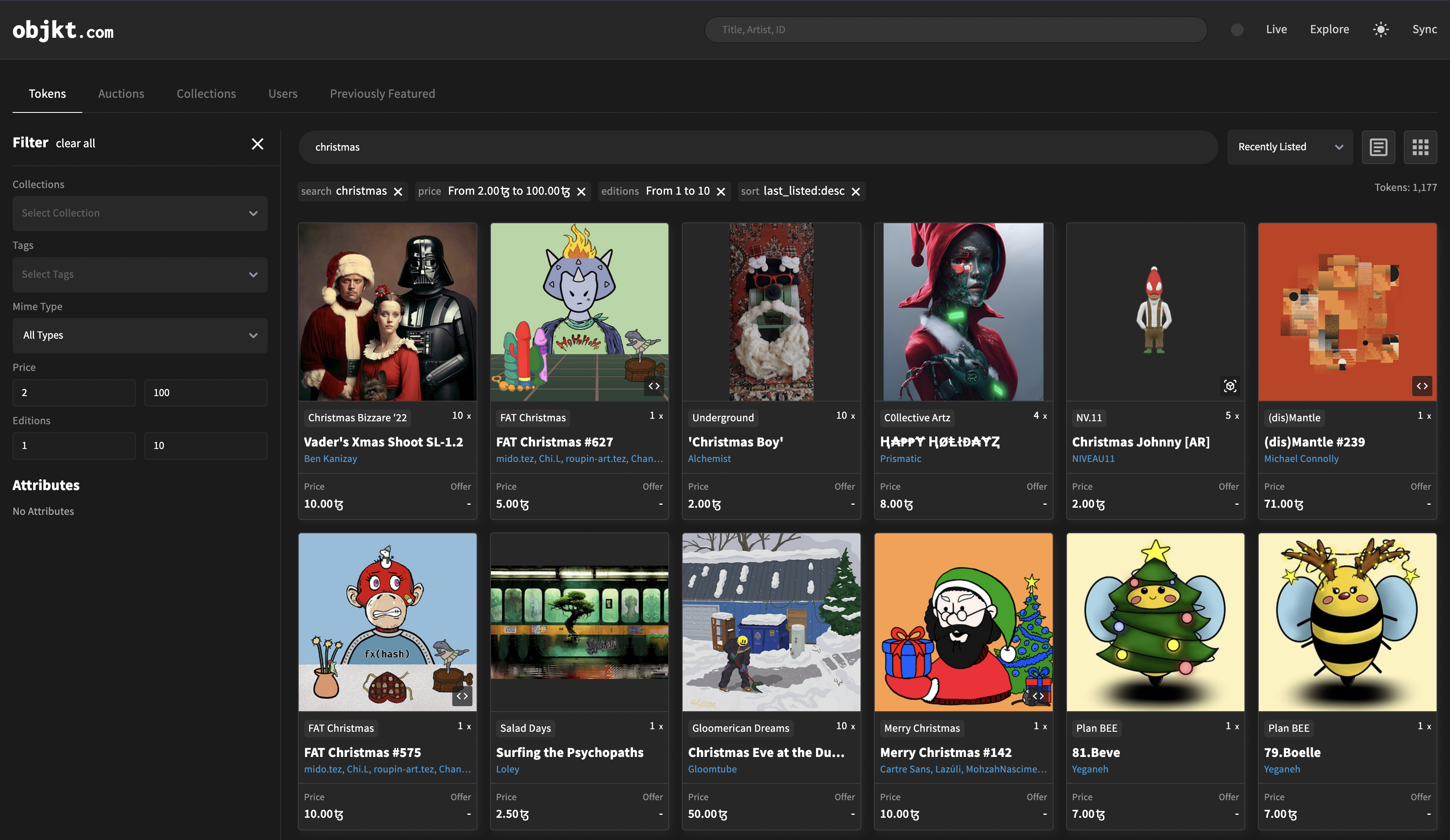
A screenshot of the Explore page on objkt.com with select filters applied to show available NFTs

Make sure to use any filters available on the website you use to narrow down your options. There’s a lot of junk out there, but many, many gems to be found. When you find an NFT that seems interesting, go check out that creator’s profile. You’ll want to support creators who show consistent, quality work. Try to avoid NFTs from creators whose profiles are underdeveloped or whose work is inconsistent. These could be signs that the person is a copyminter (a fraud).

My process to find NFT gifts on objkt.com goes like this:

Search for a term in the search bar at the top of the page

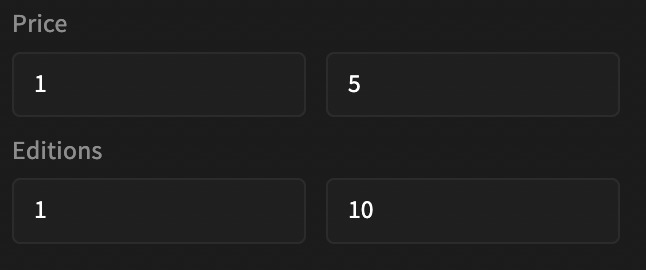
Here are some example filters I would use on Objkt.com.

A screenshot of two of the filters available on objkt.com, Price and Editions

The price field is asking you for prices in tez, not in dollars. Now, at the moment I write this, 1 tez (remember: $XTZ on exchanges) is trading for $0.80, so it’s not a huge difference. But crypto prices gonna do what crypto prices do, and the price will be different for you. Last year the price of 1 tez was up to $4, and it could even go higher in the future, so just be aware of what you’re spending here.

The editions field allows you to narrow down what types of works you want to return. Single-edition pieces, also known as 1/1s, are thought to be the most valuable NFTs, because they can only ever be owned by a single person. Therefore, they will often be priced more highly than multi-edition NFTs. But because of their uniqueness, they can also make great gifts. (See the Nifty Dictionary entry on 1/1s for more about this type of NFT.)

Multi-edition NFTs are works for which more than 1 edition exists. For these NFTs, it means that there are multiple copies available that are functionally identical except for their token IDs. It’s just a different format that artists can use to sell their work. (For more on multi-edition NFTs, see the Nifty Dictionary entry about them.)

On the Tezos network, creators can typically mint up to 999 editions of a single NFT. On one marketplace, I even saw edition numbers of 1 million. Now, there’s nothing wrong with buying an NFT that has 998 (or 999,999) other editions, but having more editions available does cheapen the NFT’s value – both from a simple supply and demand standpoint (high supply means lower demand), and also a simple psychological perspective, which is what drives most of the value in NFT secondary markets.

So I find that, generally speaking, NFTs with just a few editions are a better buy than NFTs with dozens or hundreds of editions. If an NFT has so many editions available, it can be a signal that the artist is new or not savvy with NFT culture, and is simply looking to make any money they can. Whereas if an artist has only released a few editions of an NFT (say around 5), that can show that they have carefully considered the value of their work, and how many people they want to be able to collect that work.

It’s not a hard and fast rule, but Objkt doesn’t give you a lot of filters to work with, so I find that limiting edition sizes to 10 is a great way to eliminate a bunch of spam and low-value NFTs right off the bat.

One final note here. Most of the marketplaces mentioned above (Objkt, Kalamint, Teia) are Tezos-only, which makes things a little more straightforward. If you’re using a website like Rarible that supports more than one blockchain, make sure to filter for the Tezos network while you’re searching for NFTs.

A screenshot of Rarible's homepage showing the Tezos network listed under the Explore button

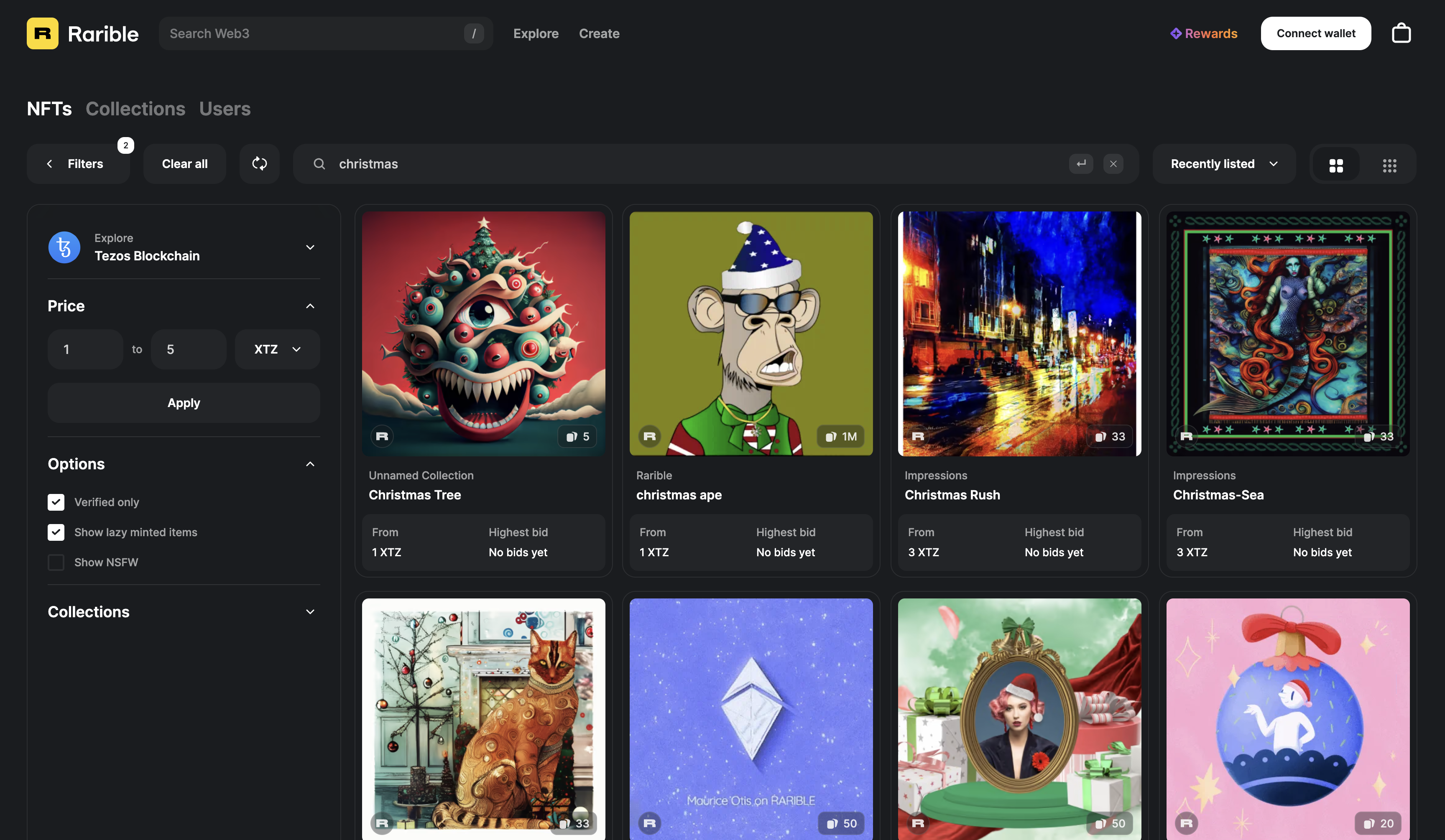
Rarible’s marketplace filters are similar to Objkt’s, but the site doesn’t let you control for edition size, as far as I can tell.

A screenshot of Rarible's marketplace page showing helpful filters applied, including Tezos Blockchain and price filters

Step 5: Purchase the NFTs

To purchase, you will have to connect your wallet to the website. On Tezos (or at least on Objkt), this is called syncing. Sync your wallet to the website. (This is basically you logging in.) On other marketplaces like Rarible, the button might say “Connect wallet.”

This action will open Kukai in another tab. Give it permission to connect to the website. (If the connection between the website and Kukai isn’t working, try another browser. Firefox works great for me.)

Now, proceed to purchase the NFTs you want to buy. Clicking “Buy” on whichever website you found the NFT on should open up Kukai in a new tab again, or prompt you on the existing Kukai tab. Follow the prompts on Kukai to complete the transaction and “Broadcast” it to the network. You’ll see the pending transaction in Kukai. After about 30 seconds, you’ll see the transaction finalize.

Congratulations! You’ve just purchased the NFT.

Step 6: Send the NFTs to the recipient

Now’s the really exciting part: emailing the NFT to a friend!

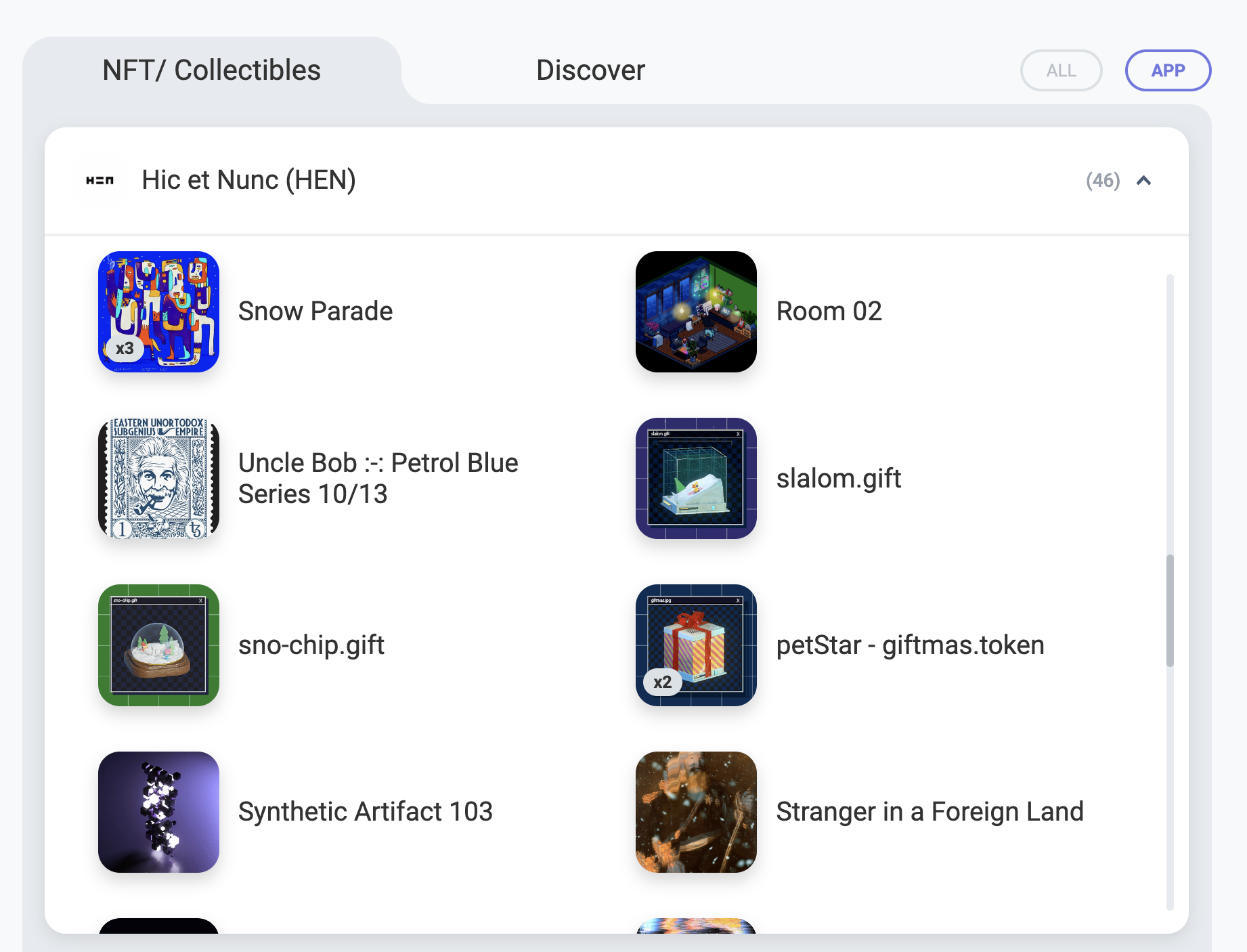
In Kukai, click on a grouping in the NFT/Collectibles tab to show you the NFTs you own from that platform. In my case, the platform shows as Hic et Nunc (which means they were minted using the defunct HEN platform’s smart contracts). If you buy your NFTs from Objkt, it will probably show under this grouping too.

Now, click on the NFT you want to send. It’ll pop up with a detail view and a giant purple “SEND” button. That’s what you want!

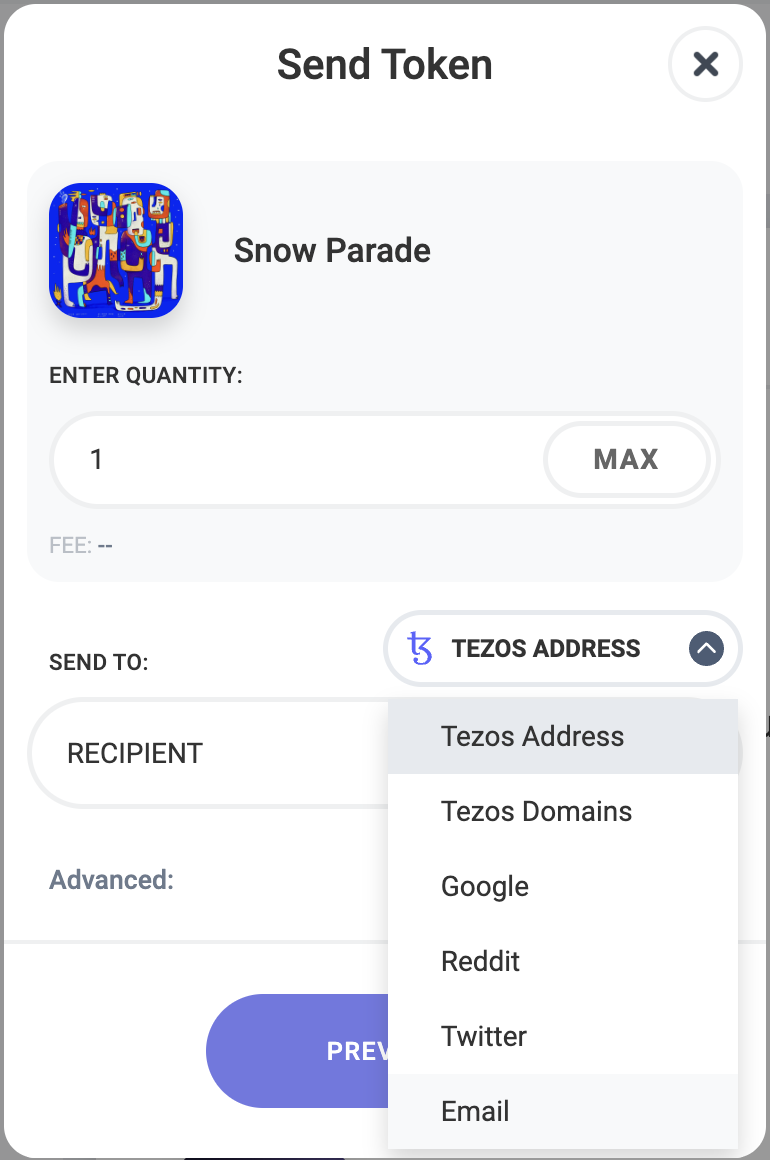
On the next screen, enter a quantity of 1, because you want to send 1 instance of the NFT. Now here’s the important bit: click the area that says “TEZOS ADDRESS” above the “RECIPIENT”. This will reveal other options you can use to transmit the NFT. You’ll see down at the very bottom of the list is our destination – email!

You’ll also notice that there are other social options here such as Google, Reddit, and Twitter. So, how does this sending-via-social-media thing actually work?

What Kukai is going to do is create a new wallet for that user. That wallet gets attached to the account you specify, such as an email address, or a Twitter account. The user will get notified on that platform that someone has sent them an NFT. Then, they will use that account to log in to Kukai and claim the wallet. At that point, they own the Kukai wallet and have ownership of the NFT! It’s a pretty neat process enabled by a solution called DirectAuth developed by a company called Torus. I’m frankly surprised not many other wallets seem to support this method yet, given it’s clear appeal.

To complete the transfer, enter the recipient’s email address, then click Preview. Continue with the prompts in Kukai to complete and broadcast the transaction. Again, you’ll see it confirm about 30 seconds after you send it.

Step 7: Help your friend receive the NFT

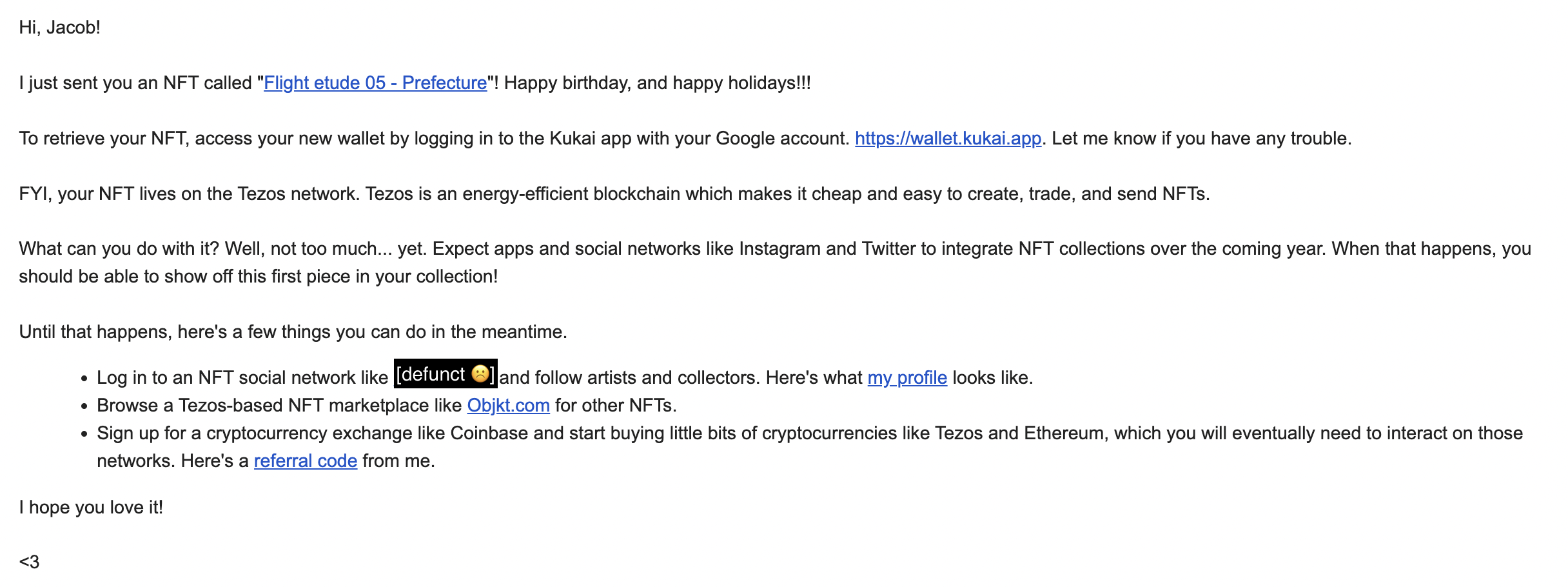
For each friend that I sent an NFT to, I sent them a little note explaining that they would need to log into Kukai.app using their email address to retrieve the NFT, and that this was totally free.

Screenshot of a typical email sent to friends telling them how to retrieve the NFT

If you don’t communicate this to them, they will have know way of knowing they received the NFT, nor how to retrieve it!

Step 8: Help your friend share the NFT they received.

After I sent NFTs to friends last year, the one question I kept getting back was, “What do I do with it?” And to be honest, I didn’t have a good answer. I mostly gifted the NFTs as a way to get them curious about the medium of NFTs – the gifting was the point of the exercise. But for people who otherwise aren’t active in the NFT world, there was not an easy way for them to display or share their NFT, which confused them.

To be honest, at the time of writing, I believe it is still the case that there’s not a great way for recipients to show off their NFTs in a web 2-dominated world. I think the most natural way for people to share their NFTs is on Instagram, which has created a special feature to show off “Digital Collectibles.” Unfortunately, Instagram only supports Ethereum, Polygon, and Flow at the moment, so NFTs purchased on Tezos can’t be shared natively on that platform.

But of course, people are free to screenshot or download the media of the NFT you sent. I would tell your friend that if they want to show off the NFT, that’s the best way to do it – just download the media and share it on their social network of choice. It’s not the most glamorous solution in terms of highlighting the unique capabilities of NFTs, but it’s a tried-and-true method that allows people to spotlight and celebrate the art you’ve given them.

Go forth and gift!

And that’s it! As I said at the top of this article, I ended up sending a LOT of NFT gifts using this method last year. And not just for friends, actually. I ran a Tiktok contest offering to send NFTs to the winners of daily giveaways. All of these recipients chose to receive their NFT by email. It was a super smooth solution and I was super grateful to have found this method.

Hopefully, we’ll see more wallet clients on other blockchains integrate the DirectAuth feature soon. And I equally hope that Instagram will begin to support Tezos and Kukai, so users will be able to share their NFTs on Instagram. Until then, I hope this guide helps you find some cool presents for your friends and loved ones, or at least send that NFT over to someone’s email. Cheers!

I Sold an Official Twitter NFT for $15,000. Who Got the Better Deal?

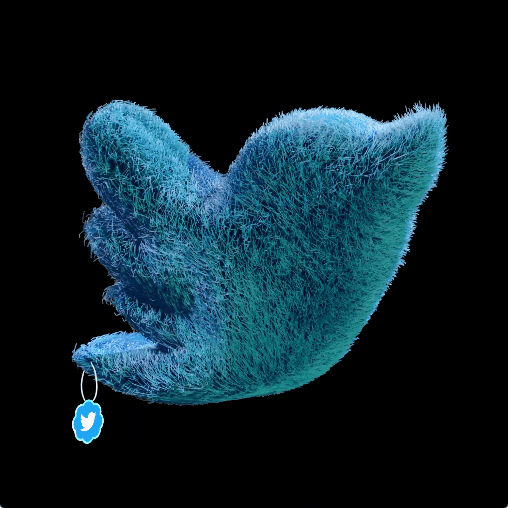
An image of the Twitter logo in the form of a fuzzy plush toy

Last week, I was one of the few lucky winners of Twitter’s surprise NFT giveaway. Just a day later, I accepted a $15,000 USDC bid for the piece. I effectively was betting that the price would only go down from there. The party on the other end of the bid – an account named “NFT Flipper” – clearly disagreed. So did many of the other winners of Twitter’s NFTs.

So who’s right? Was this a historic drop whose value will be clear for years to come? Or did I pick the right time to cash out on a flash-in-the-pan drop?

This post will lay out why I thought $15,000, and an excellent price to accept for a piece in Twitter’s “140 Collection.”

The Drop

In a flash marketing stunt on June 30th, Twitter revealed twenty editions of seven NFTs they had created as part of a series they called “The 140 Collection.” (That adds up to 140 total editions, by the way – the traditional number of characters allowed in a tweet.) The NFTs were minted on Rarible as ERC-1155 tokens.

Twitter distributed the pieces via their own Twitter account by engaging with users who commented on the announcement. Editions were awarded seemingly at random to some users who requested one.

I happened to be one of those lucky commenters who received one. After commenting on my reply, @Twitter DM’d me, asked me for some personal information (I assume for tax or KYC reasons), and then sent over an NFT to the wallet address I supplied them.

Twitter sent me an edition of Furry Twitter – a looping image of the Twitter logo done up like a stuffed plushie you’d hang on your rear-view mirror. (As far as the art goes, I think it’s pretty decent! I appreciated the understated, realistic animation of the bristling fur. I’m not so sure about the tag on the tail showing the Twitter logo – besides being redundant, it seems to add a 2D element into a 3D image. But overall, they could have done much worse for a first NFT outing.)

I was, of course, delighted to have won! It seemed like everyone on NFT Twitter, including some big name artists, were begging to own one of these. I quickly spotlighted the new trophy on my Showtime profile, looking forward to reading the comments as they came in.

But, of course, just as soon as the nifty hit my wallet, I headed over to OpenSea to check its value on the secondary market. That’s when I saw that an edition had already sold for 25 ether (about $52,000).

Was I really holding a $52,000 image in my digital wallet? I was not convinced of that, but nonetheless, I listed it for 25 ETH in case someone was inclined to disagree. 😜

It was at this point that I started to consider the value of this nifty. What was the quality of the art and the technical execution? What was the broader significance? What would I have paid for it? What would I expect excited collectors to pay for it? Did I think it was likely to increase or decrease in value?

I determined that it was probably worth a few thousand dollars. Any amount over $10k was certainly an overvaluation. And therefore, I would be happy to trade around that price.

Here’s how I decided the Twitter NFTs were overvalued.

The NFTs were officially created by a corporation. The crypto space broadly, and much of the NFT community, comes from an anti-authority, anti-centralized perspective that sees large corporations as untrustworthy and often immoral. Given that political and cultural context, I could easily imagine that in a year, Twitter’s NFT drop would look more like a cringey publicity stunt from a corporation trying to capitalize on a trend and less like a historic, forward-thinking evolution of a beloved brand.

Having decided that, I started to keep an eye on the bids, and checked them regularly over the next 24 hours to see how the market was reacting. The bids kept going up, reaching a high of $15,000 USDC on OpenSea. For most of the day, there was a comfortable ladder of supporting bids in the same neighborhood.

But then I noticed the ladder disappear, and suddenly the next highest bid was around half of that USDC offer. That told me that many of the supporting bids had probably come from a single account, a potential indication that there wasn’t a lot of demand from a large pool of people; and that one holder now had a short-term opportunity to take a decent bag of cash.

Since the price was well over what I valued it for, and since there was now a time-sensitive opportunity to accept this bid, or one much lower, I decided to accept, and did so.

Now, key to my decision was my sense that there was no ongoing mechanism to sustain or increase the value of these pieces, no community to rally around the collection.

But as soon as I sold, a funny thing happened: the other winners started connecting and organizing on Twitter. They talked about the value they saw in the pieces; made promises not to sell soon; and closed ranks to lock in the price of the art. They followed each other and formed a private Discord server. (I, of course, asked to join the club given my status as an original winner, but was politely told that the server was open to holders only. I find this response to be both ruthless and extremely fair! 😆)

And here’s the thing – their approach may be a viable way, maybe even the only way, to sustain and grow the value of The 140 Collection. By keeping the NFTs visible in the community; by touting their value and historic nature; by coming together as a cool kids club and making communal decisions – these holders are forming exactly the sort of invested community who has the incentive and the ability to protect the value of their prizes.

Now, I feel as though they and I are on opposite sides of a bet: I made my wager that the value of Furry Twitter wouldn’t go much higher than $15,000. They bet that the minimum value is much higher. I look forward to tracking the collection price and seeing who turns out to be right.

OPERATION MELT ‘FACES’: Nearly $1 million Value ‘Melted’ by Collectors

The numbers are now in for an ambitious NFT experiment that challenged collectors to “melt” an extremely popular NFT in exchange for a reward: Nearly a third of holders of the SSX3LAU piece “FACES” participated in the operation, pouring almost $1,000,000 in estimated value into this digital smelting operation.

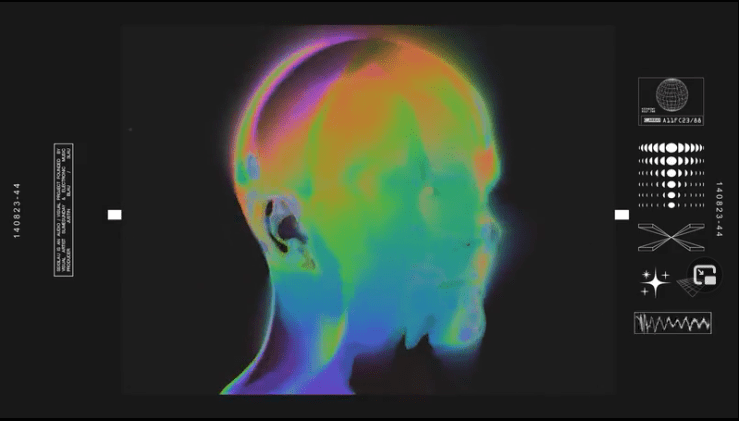
A face made up of bright shapeshifting colors spins slowly

At the time of writing, the value return for all participants has been underwhelming. Since the event, which took place around the peak of the frenzy in the Nifty Gateway marketplace, prices for most NFTs – including FACES – have cratered. GLASS, the piece given to collectors who burned the most FACES, has been selling for less than its established value of six times the price of FACES.

Those who melted one edition FACES have yet to receive their promised loyalty token, so the value of that piece has yet to be established. But it seems unlikely to match the value of a FACES piece based on its own merits. (UPDATE 5/7/2021: the loyalty tokens were distributed today and are much cooler than was initially previewed.)

Despite this, OPERATION: MELT FACES was a useful experiment in NFT tokenomics that offers many lessons to artists and collectors. And, as any HODLER knows, near-term price changes are not necessarily reliable indicators of long term value. Upside remains for holders of these pieces given the artists’ intentions to reward long term holders of their work.

My findings are based on original research and analysis. I used Dune Analytics to review the transaction data that was publicly available around OPERATION: MELT FACES, and combined that with numbers gleaned from the Nifty Gateway ecosystem.

In this piece I will walk through my analysis of the operation, the current state of the market after the burn, and my personal reflections on how the event went overall and how it could have been improved.

BACKGROUND: OPERATION MELT FACES

Last month, NFT superstars Justin Blau, known as 3LAU, and Mike Parisella, aka Slime Sunday, announced a surprise: holders of their multimedia NFT piece “FACES” were invited to destroy their editions in order to receive a new piece of art. They called this OPERATION: MELT FACES. (The artists’ combined alias is SSX3LAU. FACES was released in the IRIDESCENT Open Editions collection on Nifty Gateway on March 13, 2021.)

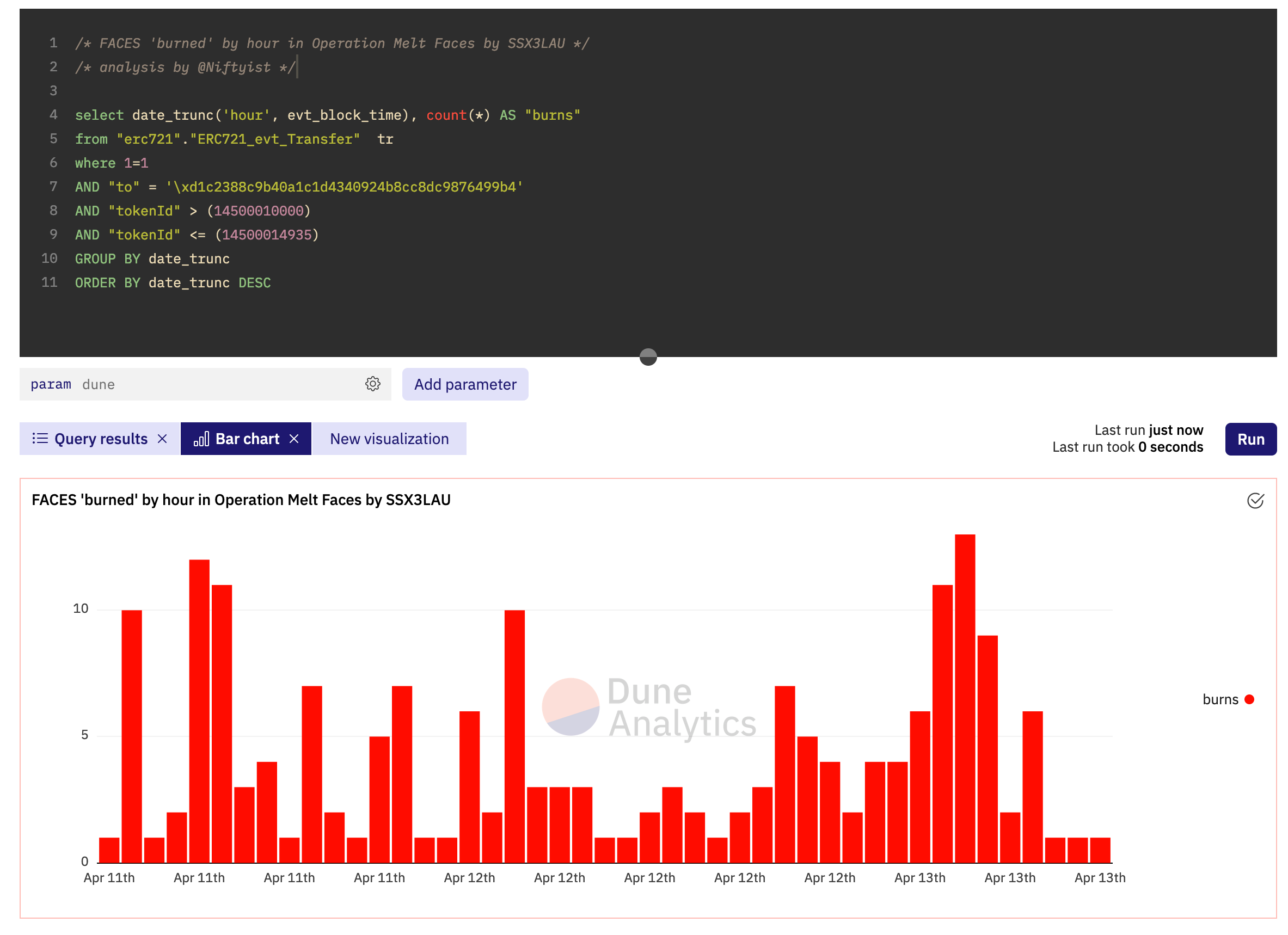
A bar graph shows sporadic increases over a 48 hour window

I participated in the event by buying an edition of FACES and “melting” (or “burning”) it in the specific manner described by the artists. In return, I was promised an NFT that will act as a loyalty token for future 3LAU/Slime Sunday events. (I have faith it will come, although at the time of writing, this token has yet to appear in my wallet.)

Burning an edition of FACES was always a risky proposition. It was the most popular piece in the Nifty Gateway secondary marketplace by trading volume. The value of FACES fluctuated wildly in the lead-up to the burn, rising from its opening price of $333 to, at times, around $1,000. Around the time of the operation, pieces were trading for around $700 (which is about what I picked my edition up for).

And the return on the burn was uncertain. How would the market value of “GLASS,” the piece gifted to holders who burned 6 FACES? How would the market value the SSX3LAU “loyalty token” distributed to holders who burned 1 FACES? How would the market reward the remaining editions, whose supply would be reduced and who would come to symbolize a certain type of loyalty to HODL idealism?

Knowing that both artists are invested in the NFT space for the long term, and 3LAU in particular has spoken about how he plans to reward holders of his art, I decided to take a shot at the burn myself. For science. And the thrill. And for the intriguing, ineffable value of an early SSX3LAU loyalty token.

ANALYSIS

For weeks, I’ve wondered about the success of the experiment. I had not seen any announcements about the operation by the artists after the burn. Had it been a flop?

When I discovered Dune Analytics this weekend – a dashboarding platform that allows for analysis of the Ethereum network using simple SQL queries – I realized I had the tools I needed to answer that question. I decided to make this the subject of my first investigation. (Make sure to check out the full dashboard associated with this post!)

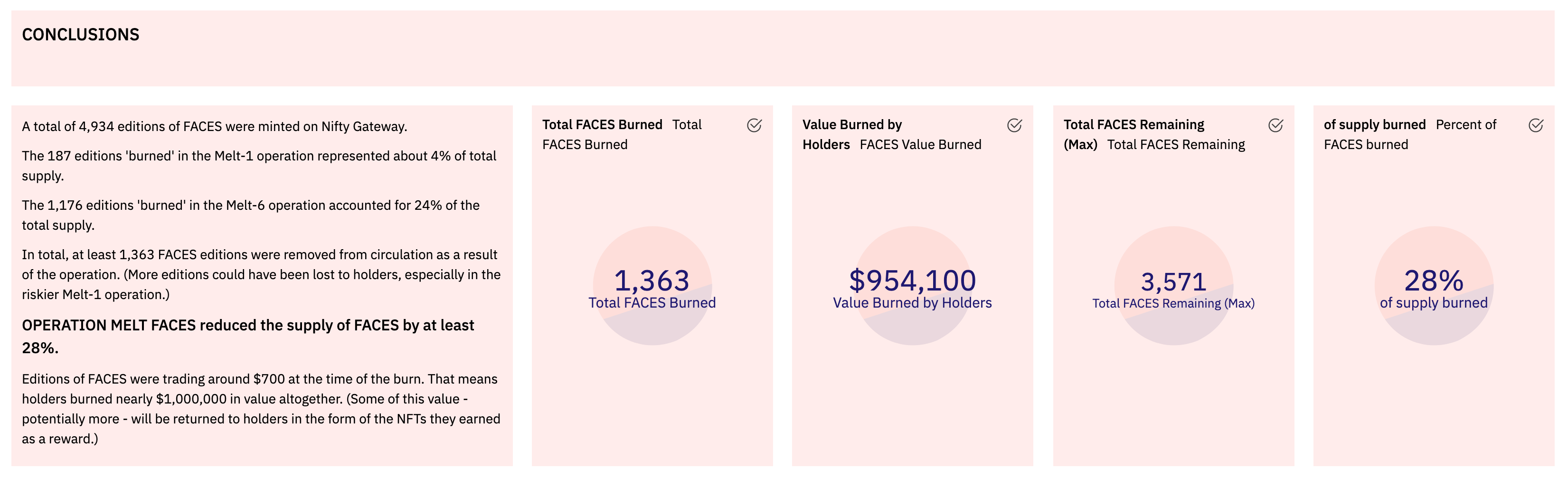
By analyzing the trading activity related to the “FACES” tokens and the designated burn account, and inferring from numbers available in the Nifty Gateway marketplace, I concluded that at least 1,363 FACES, representing a combined value of $954,100, were “melted” in the burn. (Note that this value didn’t necessarily disappear: Those who burned FACES will retain the value of whatever tokens they receive(d) in reward for the burn.)

IMPACT ON PRICE

FACES had been one of the most successful offerings ever on Nifty Gateway, with nearly 5,000 pieces minted. The FACES burn reduced supply of the piece by at least 28%. Yet, despite the sacrifice of over 1,000 pieces, we did not observe an increase in the value of FACES immediately after the event. Rather, price fell considerably almost immediately after the burn. Thus, the operation did not achieve a boost in demand for the piece, at least in the short-term.

(Note that in the roughly two weeks since the burn, prices have collapsed across the entire secondary market on Nifty Gateway. FACES and GLASS have not been spared from this phenomenon, which makes it difficult to isolate the effect of the operation on prices of these two pieces.)

At the time of writing, FACES is trading for around $400 in the Nifty Gateway secondary marketplace. Niftysecondary.com shows a steady gradual decrease in value from around $450 on April 16th, the farthest back date for which data was available. (The burn event concluded at 12AM pacific time on April 13.)

At the time of writing, the last four editions of GLASS traded hands for just $2,000 – less than the estimated value of 6 FACES at the time of the burn ($4,000), and less than the current value of 6 faces (about $2400).

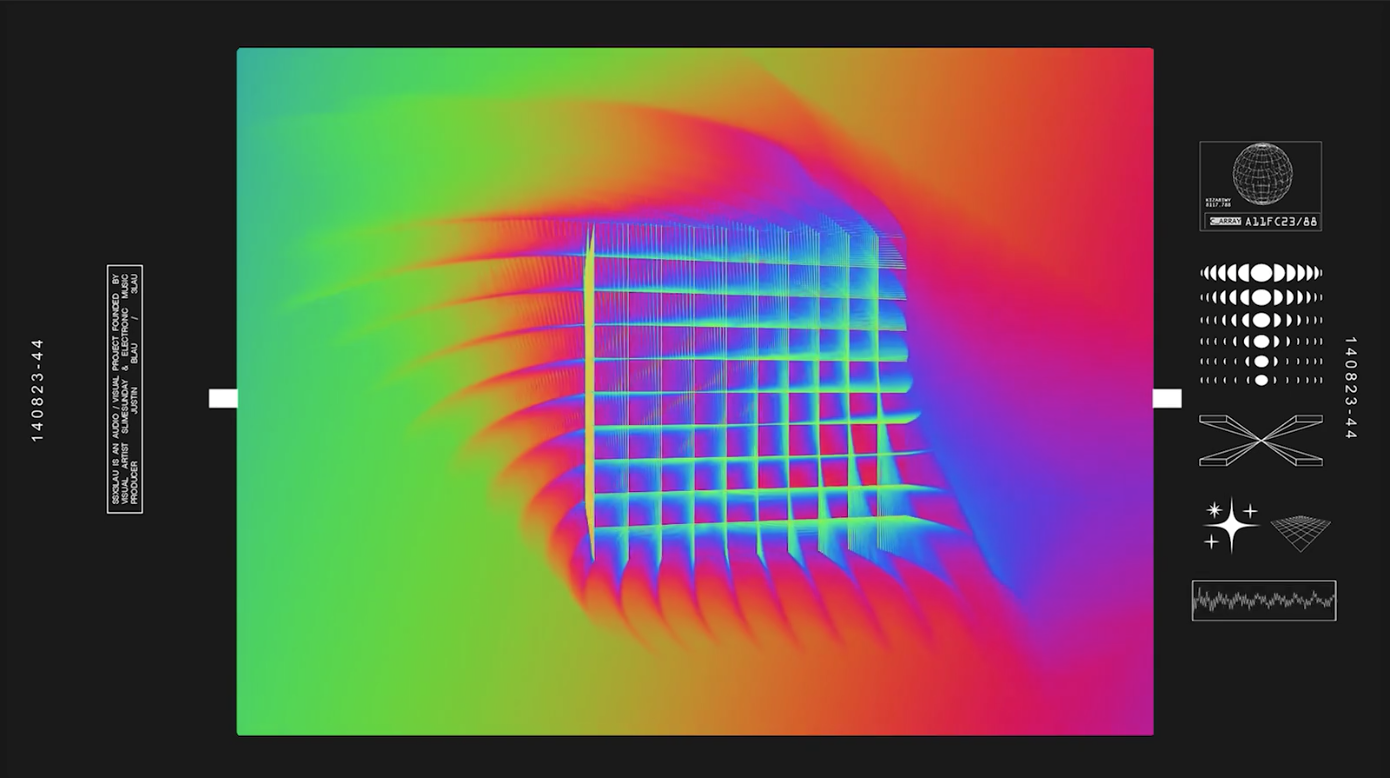
A 9x9 cube made up of bright shapeshifting colors slowly spins

MISSION ACCOMPLISHED?

Was the experiment successful? From a participation standpoint, I do think it’s impressive that the artists managed to engage almost 30% of buyers in this elaborate and novel scheme. That being said, I think the participation rate could have been higher, as I will explain in the next section.

From a value standpoint, I do not think OPERATION: MELT FACES achieved its goals, as far as we can judge in the present. OPERATION: MELT FACES had the potential to be a value-add exercise for all four parties involved:

The artists, who benefit from a 10% resale fee any time FACES or GLASS is traded

In my estimation, the four parties not only made out quite differently, but there was actually a value transfer that created winners and losers from the operation.

The artists made out the best, having collected thousands of dollars in pure profit from resale fees as prices rose and then ultimately fell around the event.

“Melt-6 collectors” were rewarded with a very cool, unique NFT. Although the value of this piece is down right now, I personally believe that if NFT prices are to recover at all to where we saw them in March, GLASS is a prime candidate to reach a premium price due to its limited supply, obvious audio and visual quality, its association with the two artists, and with OPERATION MELT FACES.

Collectors who held on to FACES have not seen the value of the piece increase in the wake of the operation, and I do not expect they ever will. (More on this in the next section.)

“Melt-1 collectors” seem to have fared the worst in the experiment. Based on pure aesthetics, the NFT they received in return for the risk they took on is clearly of lesser value than the original piece. (More on this in the next section.) Not to mention, since it is being distributed outside of the Nifty Gateway closed ecosystem, there will be hefty fees associated with any trade of the loyalty token. For their sake, I do hope SSX3LAU does their best to create long-term value for holders of the token. (UPDATE 5/7/2021: the loyalty tokens were distributed today and are much cooler than was initially previewed.)

From an artistic and entrepreneurial standpoint, I love the concept of OPERATION: MELT FACES, and I think it was well worth undertaking. This type of experiment highlights the unique value of NFTs and is a fun, tongue-in-cheek way to explore the many possibilities they open up.

But since the operation failed to create value for all holders involved, my overall view is that OPERATION: MELT FACES should be considered a mixed bag at best. I think the artists would agree with me that fans who were bold enough to participate in the experiment should be rewarded with some sort of fair value exchange, if not a value add. And if the ultimate winners from the exercise were mostly the artists, that risks turning off fans and collectors in the long term.

The camera zooms in to endlessly repeating rows of the letters SSX3LAU, white on black

CONTRIBUTING CIRCUMSTANCES

In this section I’ll explore the factors that I believe contributed to the disappointing result.

In one important aspect, the project was a victim of its own success. The astronomical minting numbers from the open edition drop may have doomed long-term FACES holders from the start. 5,000 editions is an almost unheard of figure in the Nifty Gateway world, and was a record for Nifty Gateway at the time. As a result, the market was flooded with these pieces. The price after the burn reflects the continuing glut in supply and relative lack of demand. (Two notes here: the IRIDESCENT drop probably got a major boost by lucky timing – happening to take place right at the peak of NFT mania on Nifty Gateway. It’s worth considering, too, as the market deflates, whether FACES contributed to the bubble burst by pulling in new NFT buyers who soon found themselves holding an item bound for deflation.)

Inconsistent communication added another issue to the mix. SSX3LAU had first promised those who melted 1 FACES that they would receive nothing but a single entry for a giveaway in return for the burn, before offering instead the loyalty token in addition to the giveaway entry. This may have led to confusion from holders, and/or turned off many who felt the burn would not be in their interest (who would give up value for nothing?).

In addition, I personally think the actual loyalty token offered was not a good value match for FACES, and fair to call “lame.” The artists’ announcement makes clear that the token was not only a second thought, but also not the result of a thoughtful creative process: “one of our first NFT experiments in 2020, slimesunday made this animation while messing with logo concepts.” (UPDATE 5/7/2021: the loyalty tokens were distributed today and are much cooler than was initially previewed.)

One other reason I believe the participation rate was lower than it could have been is that I did not observe much publicity around the Operation during the launch. Apart from one tweet from 3LAU, I didn’t encounter any other reminders that the melting was in progress. I believe SSX3LAU could have used their platforms more aggressively to get the word out.

Finally, one potential contributing factor to the large drop in price could be competition. Soon after the FACES burn, the much more publicized multi-day drop by PAK on Nifty Gateway employed a similar burn mechanism – and that drop, too, succeeded in minting thousands of open edition pieces. It’s possible that the PAK experiment stole some of SSX3LAU’s thunder – and demand.

PREPARING FOR FUTURE MISSIONS

In order to create the most value for fans, and not just the artists, future exercises modeled off of OPERATION: MELT FACES should take heed of the above circumstances, and make one key change in the structure.

Instead of releasing the initial token as an open edition, which introduces variability into the total number of editions minted, future artists following this model should limit the drop size to a fixed number of editions. The number should err on the small side in order to ensure continual demand for the piece during and, crucially, after the operation. Consider that if even 1,000 editions of FACES had been released, a similar burn rate of 28% would have left over 700 pieces still on the market – still many more editions than in vast majority of collections, and a number almost sure to deflate demand.

OPERATION: MELT FACES was an exciting exercise to participate in, and one that was highly affected by the time of its release. Despite the less-than-stellar value produced for some holders, it will remain an innovative drop structure and an important case study in how to optimize value for fans in similarly structured releases.

Holders of the FACES and SSX3LAU loyalty tokens will at least be able to point to an interesting piece in their collection that was part of a pioneering experiment in NFT tokenomics. And, who knows – it may turn out that in the coming months and years ahead, these tokens may still hold secret value yet to be revealed.

The Popping of the Nifty Gateway Bubble

Something bizarre happened this week when Duke Dumont dropped his debut collection on Nifty Gateway: only one person bought into an open edition piece, effectively turning what should have been a solid middle-tier open edition NFT into a unique 1 of 1.

The piece, Morganite, was a collaboration with LOREM in the DREAM LOGIC Open Collection. This stunning, subtle video loop was priced at $1,500, which marks it as a mid-to-high tier item by the pricing standards on Nifty Gateway in recent months. (The lucky buyer has now listed the piece for a cool $3,333.)

It’s not clear exactly why only one edition sold. It’s possible that buyers experienced technical issues when trying to check out – a dishearteningly common experience on Nifty Gateway.

But it’s also possible that there was simply no demand for this NFT. My hunch is the latter.

(As a contributing circumstance, I would point to the fact that there was another open edition piece in the same collection that was extremely similar to Morganite, but priced $1,000 lower. That piece, Amethyst, sold only 9 editions. In my opinion, the pieces were not differentiated enough for most buyers to justify spending the extra 1k on Morganite.)

Malavida Stage 2 Drop Falls Flat

But Dumont is far from the only artist whose drops have been met with lackluster demand in recent weeks. Malavida, a celebrated NFT artist who had a successful previous release on Nifty Gateway, also released a drop this week that struggled to meet the expected demand. Her collection was called Onboarding — Heal The Deal Stage 2, and appeared to be only open to those who had purchased pieces from her first collection.

Each piece the Stage 2 main collection was released as a drawing, with four of the five pieces priced at $1,499 or higher. Despite selling 180 editions of her first drop, patrons of Stage 1 did not seem to take advantage of their exclusive access to stage 2: only 14 editions of the $1,499 piece were sold, and a combined 21 editions were sold of the 3 pieces priced at $1,900.

Now, those sale numbers, I would argue, are nothing to sneeze at. But what takes the shine off them is that the drawings for most of the above pieces were limited to 40 editions. Which means that even the best-selling piece in that collection only sold 8 pieces – a dismal 20% of the edition limit.

Perhaps this was as expected, and they just wanted to be safe and place an upper limit on the drawings. (I say ‘they’ as my understanding is that the artists work with Nifty Gateway to determine optimal pricing.) But in general, drawings have low limits, so that demand is much higher than supply, which ensures that it’s exciting to actually win. I’m going to guess they were expecting more of the Stage 1 crew to follow through on this drop – much more.

This may have challenging implications for Stage 3 of the project, which will feature the ability for holders to combine their works into diptychs and triptychs. Hopefully, Stage 2 owners are aware of the privilege they purchased for what promises to be an interesting finale.

Trouble Across the Board

Judging by the conversation in various Discords and on Twitter, market watchers have noticed an unfortunate trend on Nifty Gateway in recent weeks – declining demand across the primary and secondary markets.

An informal survey of a variety of metrics – the number of open editions minted in recent drops; the number of drawings entered; the number of higher-priced pieces being snapped up; and the final sale price of auctions – suggests the money has stopped flowing from collectors at the generous rate it was in February and March.

There could be any number of reasons for the slowdown, and the niftysphere certainly is awash with theories. Many complain that Nifty Gateway has focused too much on quantity over quality, flooding the marketplace with big-name artists hawking expensive pieces, and middling-quality art. For all of the new blood entering the NFT space since the beginning of the year – and there have been many, many newcomers – NFTs remain an extremely niche market, and there are only so many collectors out there, with so many dollars. Market saturation is a real threat.

Panic in the Secondary Market

We’re seeing demand drop not only in the primary market, but the secondary as well. A number of pieces that I have collected are now selling below their initial list price. This is a particularly ominous sign for pieces that were priced below what seems to be the market standard of $700 and up. If the affordable pieces can’t keep their declared value, what does that say about the rest of the market?

On Twitter today, Duncan Cock Foster, one of the cofounders of Nifty Gateway, admitted that Nifty Gateway bears some responsibility for the current bearish situation, and implied they have hurt the health of the secondary market.

The NFT bubble of spring 2021 may be popping before our eyes. Here are some of the questions that come to my mind for me as we finally cross this inevitable threshhold into a more rational pricing environment on the best-known curated NFT platform.

Will this first wave of NFTs released on Nifty Gateway and other curated platforms hold their value long term?

An Artist Donated This Innovative NFT to the Public. Someone Stole it Immediately.

Last week, artist Steven Baltay, who goes by the handle @realimposter on Instagram, minted a and daring experiment in NFT art. He called it Public Domain, and declared that, “This NFT will belong to the public. The artwork itself holds the seed phrase to the wallet containing it. Please do not buy, sell, trade or destroy this art. It belongs to everyone.”

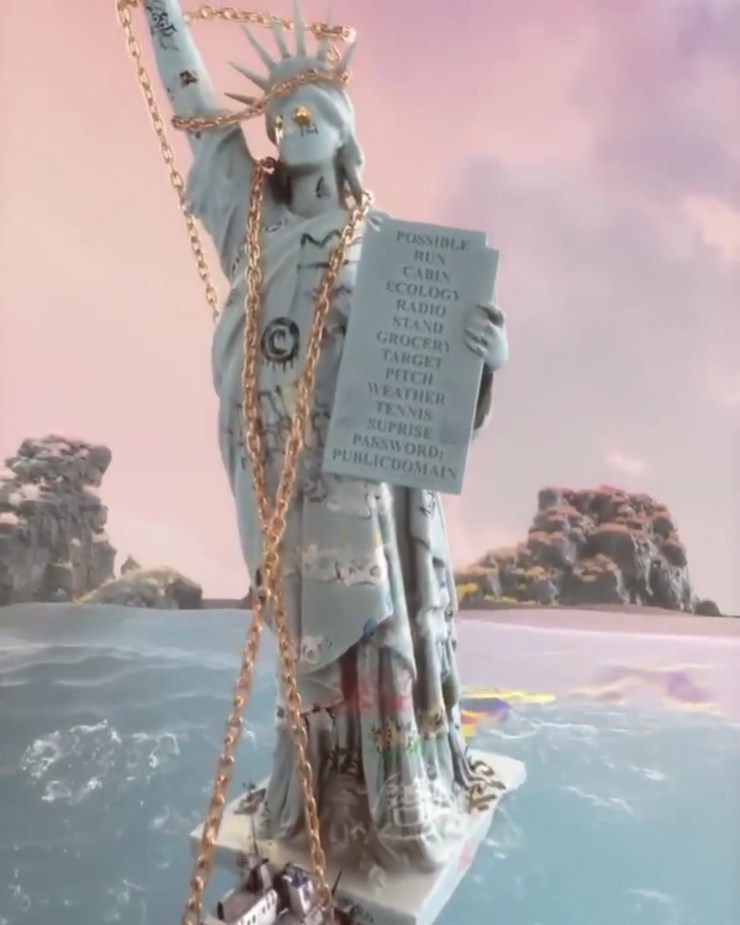
The work shows a graffitied Statue of Liberty bobbing atop an undersized cargo ship in rough seas. Liberty is chained to the ship; the golden chains sway and clink, tangling around her crown and torch. Her tablet is clearly visible, and on the tablet is inscribed the seed phrase of the wallet holding her.

For those unfamiliar, a seed phrase is a 12-word phrase that acts as a recovery mechanism for a crypto wallet. The phrase must be kept secret, or else the contents of the wallet will become forever accessible to intruders. An NFT, as a tradeable object living on the blockchain, must be kept inside a wallet. Baltay had set up a dedicated wallet, placed this Public Domain inside it, then effectively gave the keys to the public.

It took about one hour for liberty to be snatched.

According to the transaction history on Opensea, a collector with the username FriesFrame transferred the NFT to their own collection shortly after it was minted. On Twitter, FriesFrame (@ChasFries) replied to the artist’s tweet announcing the piece, saying, “nabbed it 😆.”

When a user challenged Fries Frame, asking, “Doesn’t it literally say “don’t transfer it”

😂🤔”, he defended himself on a technicality: “it does not – it just says dont buy, sell, trade, or destory….i traded nothing for it”.

According to Fries Frame’s Twitter bio, he is a Chicago based collector and “Niftygateway Moderator” (Discord?). He seems to be quite active in the space, tweeting frequently about NFTs, and his Opensea profile shows a collection of dozens of pieces.

On Twitter, I asked him what he was intending to do with the piece – lock it up indefinitely (that is, to hold it) or turn it for a profit (sell)? His answer – “why are those the only two options?” – was noncommital.

It’s interesting to consider Fries’ options. If he holds it, he can claim the distinction of being the only owner of this unique NFT – though that will always come with some notoriety. He could sell it, certainly, and any price he charged would be pure profit into his pocket. But to return the piece to the original wallet would presumably cost him gas fees – meaning if he chooses to put it back in its place, he will actually need to pay money to do so. At the time of writing, the gas fee might range from $50-$100 – not quite pocket change (at least in USD!). What would you do?

I love this piece as a tribute to and a test of the technology it’s built on. It wouldn’t work as anything other than an NFT. Because of the blockchain, we can always know who owns it, and who has taken ownership of it at any point in time.

At face value, Public Domain is an optimistic yet naive tribute to the crypto community. But being born of the community itself, I think we can conclude that it is in fact a statement on the value of trustlessness – central to blockchain technology and crypto ideology. When you allow people to take something for free, they will. Passwords, seed phrases, wallet keys, and all the other accoutrements of the blockchain are the essential tools that enable this community to thrive in spite of our tendencies toward opportunism.

With all of the excitement in the crypto space last week – the Coinbase IPO, the multi-day Pak drop extravaganza on Nifty Gateway, the Artvatars launch, and the Paris Hilton NFT debut – Public Domain seemed to fly under most people’s radar. I believe that this piece is an early classic of NFTs, and whoever owns it – Fries Frame, the public, or anyone else – will be holding a piece of history.